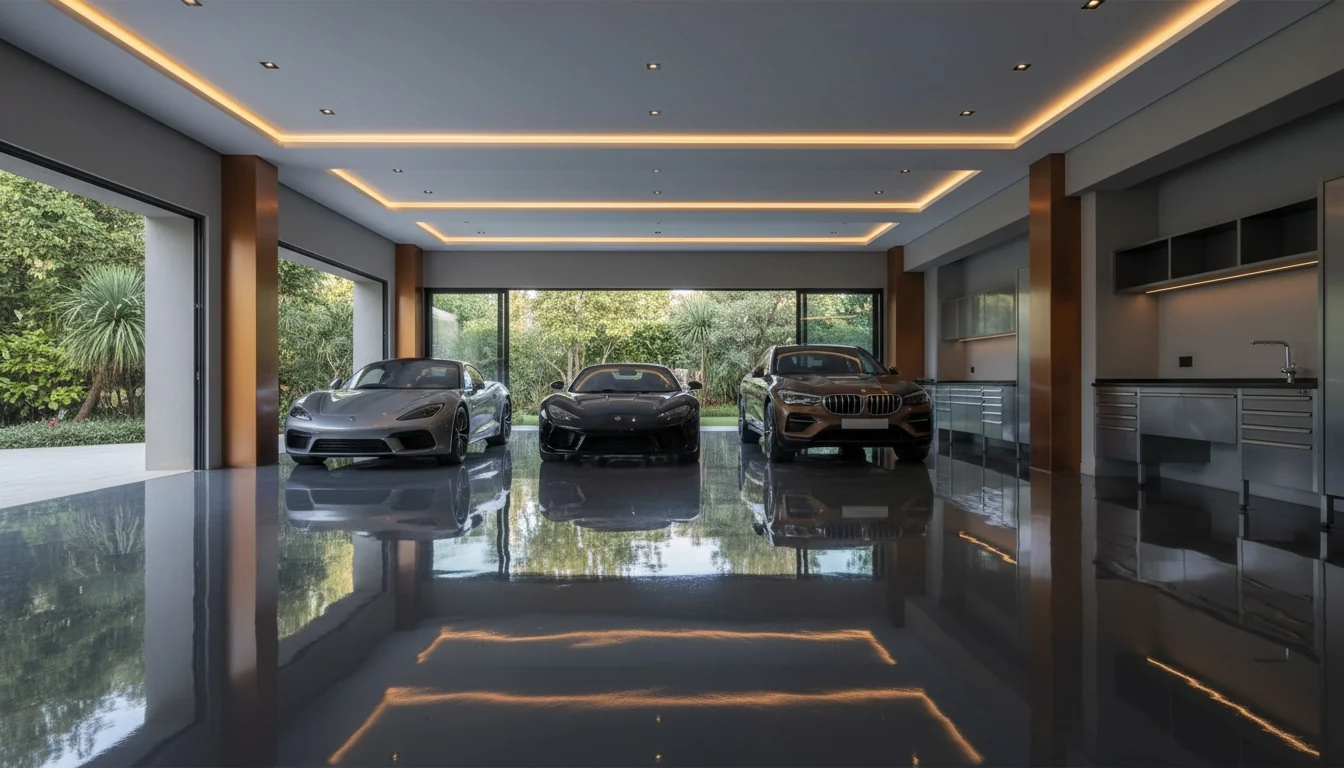
Epoxy Flooring in Sandton
Epoxy flooring in Sandton for corporate receptions, showrooms, boutique retail and the homes of Sandhurst, Hyde Park, Morningside and Bryanston — metallic, flake, solid-colour and commercial systems, installed by our appointed installation team. Free on-site quote.
What a Sandton floor has to do
Sandton is Johannesburg's financial district. It holds a large share of the city's A-grade office space, the retail of Sandton City and Nelson Mandela Square, and the Gautrain station on the corner of West Street and Rivonia Road. Around that core sit some of the city's most established residential suburbs — Sandhurst, Hyde Park, Illovo, Morningside and Bryanston — with Rivonia, Sunninghill and Woodmead mixing office parks and homes further north.
That mix produces two very different briefs. In a corporate lobby or a showroom the floor is part of the brand: it sits under glazing and downlights that show every scuff, and it is expected to look the same on a Monday morning as it did at handover. In a Sandhurst or Bryanston home it is part of the architecture, running from the entrance hall through open-plan living to the patio. Epoxy suits both because it is one continuous surface — no grout lines to stain — and it can be finished in high gloss, satin or matt.
If you have not specified it before: epoxy flooring is a two-part resin, a base and a hardener mixed on site, that cures into a hard, chemical-resistant layer bonded to the concrete. Unlike floor paint it builds real thickness, and most of its performance depends on the preparation underneath.
Epoxy systems we install in Sandton
Four systems cover almost every floor in the area. Prices are indicative installed rates per square metre.
| System | Best for in Sandton | Indicative price | Time on site |
|---|---|---|---|
| Solid-colour epoxy | Back-of-house corridors, storerooms, parking-level lobbies and home garages that simply need to be sealed and easy to clean | R250 – R400 / m² | The shortest programme: a garage-sized area typically runs two to three days from grinding to walk-on |
| Epoxy flake (flake-chip) | Home garages, gyms, staff kitchens and change rooms, where grip and a finish that hides scuffs matter more than gloss | R350 – R1,200 / m² | Similar to solid-colour, plus the chip broadcast and a clear sealing coat |
| Metallic epoxy | Reception areas, showroom floors, entrance halls and open-plan living spaces where the floor is part of the design | R450 – R1,500 / m² | Longer: more coats, and more curing time between them |
| Industrial / self-levelling | Parking basements, loading bays, workshops and high-traffic retail floors | R300 – R800 / m² | Set by build-up thickness and area, and can be phased in sections around trading |
Every system needs time to cure before it takes foot traffic, and longer again before vehicles or heavy equipment. The showpiece option is a poured metallic finish; the workhorse for basements, loading areas and busy shop floors is a commercial-grade epoxy system built to the thickness the traffic calls for.
What epoxy flooring costs in Sandton
Installed epoxy runs from about R250 to R1,500 per square metre, and the same indicative bands apply in Sandton as across the rest of Johannesburg. What decides where your floor lands is the floor itself:
- Area. Setup is shared across the floor, so a large open-plan office usually earns a better rate per m² than a single reception.
- The system. Solid-colour sits at the bottom of the range; metallic uses more product and more skilled hand-work, so it sits at the top.
- The slab's condition. Old coatings, glue from lifted carpet tiles, oil in a garage or tiles still in place all add preparation time.
- Access and timing. A tower lobby that can only be worked after hours, goods-lift access or a basement with limited headroom changes how the job is planned, and that goes into the written quote.
As an indicative illustration only: at the bottom of each band, a 40 m² reception works out at R10,000 in solid-colour (40 m² × R250) and R18,000 in metallic (40 m² × R450). Those are arithmetic floors: a typical complete job starts higher once the slab has been assessed, which is why our price guide puts even a 36 m² double garage from R12,000. For the full band-by-band breakdown, see our epoxy flooring price guide.
Commercial epoxy flooring in Sandton
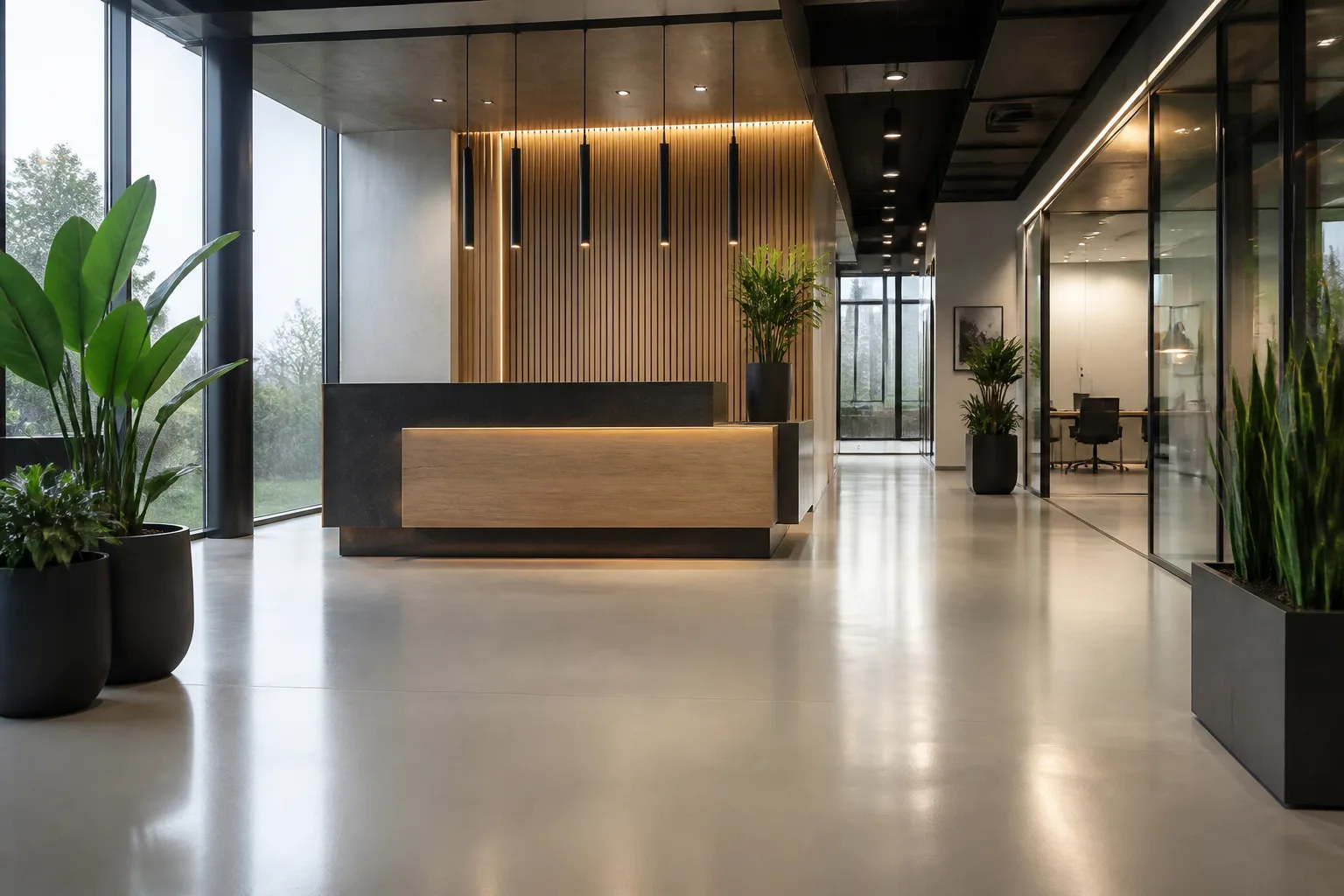
Corporate receptions & office floors
A lobby is the first thing a visitor judges. A seamless light-grey or solid-colour epoxy gives a clean, continuous surface with no grout lines to stain, and it holds up under heels, delivery trolleys and the daily mop.
Showrooms & boutique retail
Display lighting shows every flaw in a floor. A metallic or high-build solid-colour system gives a showroom a depth that tile can't, and a clear topcoat takes the scuffing from constant foot traffic instead of the colour coat underneath.
Hospitality & back-of-house
Restaurant kitchens, hotel service corridors and staff areas need a floor that washes down and doesn't hold spills in joints, with texture in the topcoat where the floor is regularly wet.
The office parks of Sunninghill, Woodmead and Rivonia add another layer of work: server-room and plant-room floors that need to shed dust, canteens that need a floor staff can hose down, and parking levels where tyre marks and oil drips need to wipe off.
A floor that is being traded on can't simply close for a week. Where your building allows, grinding and coating can be planned for after hours or weekends, and a large floor phased in sections so part of it stays in use — ask about this when we visit and we'll build it into the programme.
Epoxy floors for Sandton homes
In the larger homes around Sandhurst, Hyde Park and Bryanston, epoxy tends to run through the rooms where people see it most: an entrance hall, an open-plan living and dining space, a wine room or a home cinema. Metallic suits these rooms because each pour is unique and the veining changes with the light through the day. If you're weighing it up, our guide to how metallic epoxy is poured and finished explains what to expect from the look.
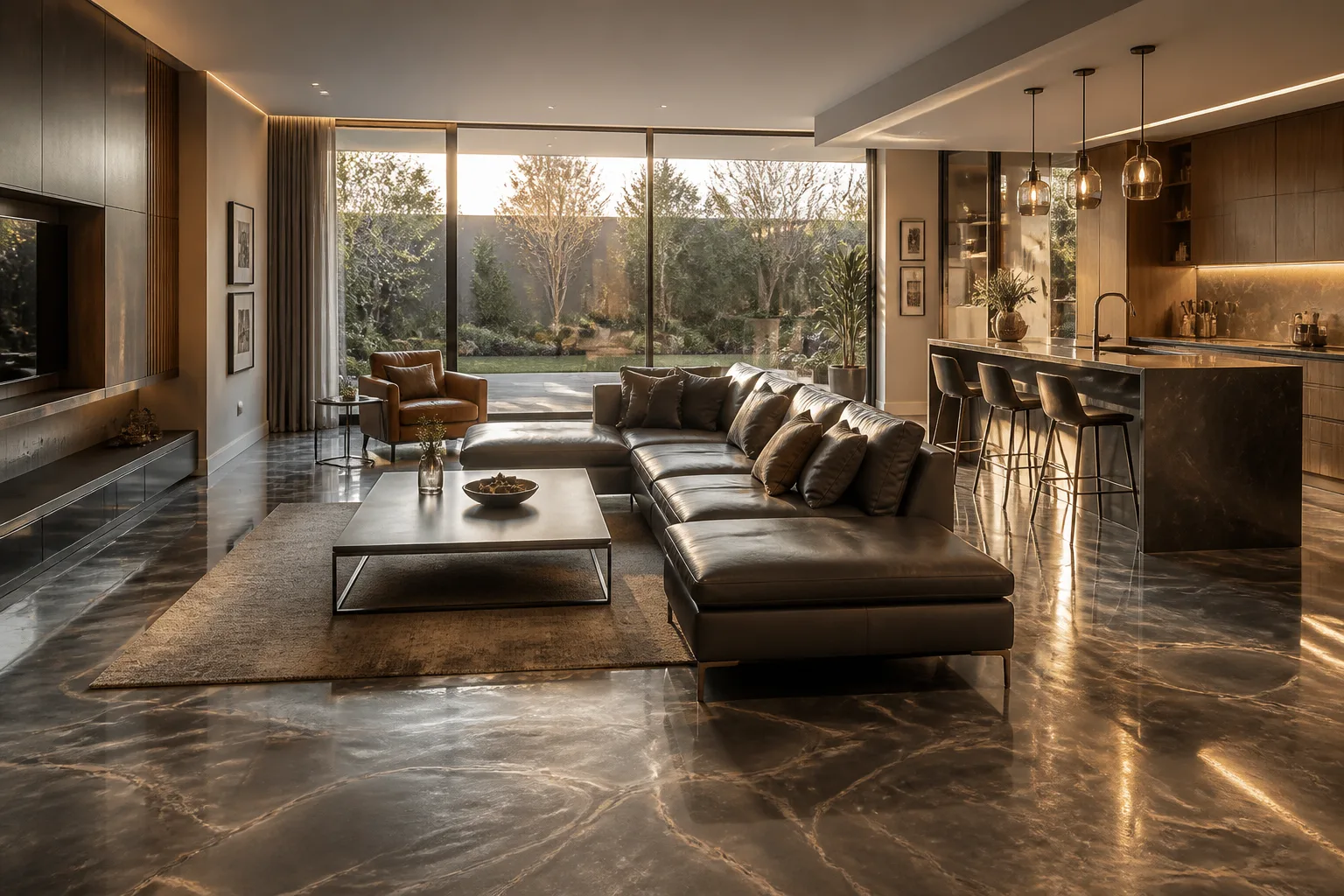
Kitchens are a strong second. A seamless floor has nowhere for spills to soak in, and a satin finish keeps glare down under pendant lights — our piece on epoxy in the kitchen covers the trade-offs. Downstairs, the garage, home gym and braai room are where a decorative flake floor earns its keep: textured underfoot, forgiving of tyre marks, and quick to clean.
How we install an epoxy floor, step by step
- 1
Site visit, measurements & moisture check
We measure, inspect the slab for cracks, old sealers and oil, and check for moisture, because damp under a coating is a common reason epoxy lifts.
- 2
Diamond grinding
The concrete is mechanically ground to open its surface so the resin can grip it. On large open commercial floors, shot-blasting is another way to achieve the same profile.
- 3
Crack, joint & pit repair
Cracks and pitting are filled and levelled, so they don't read through a glossy finish once it's lit.
- 4
Primer
A primer coat soaks into the freshly opened concrete and gives the body coat a sound base to bond to.
- 5
Body coat, broadcast or metallic pour
The colour coat goes down. For flake, chips are broadcast into it while it's wet; for metallic, the pigmented resin is poured and worked to create the movement in the finish.
- 6
Topcoat
A clear or tinted topcoat seals the system, with anti-slip texture added where the floor will get wet, and a UV-stable polyurethane where it will see sun.
- 7
Cure & handover
The floor cures before foot traffic, and for longer before vehicles, furniture or equipment. We give you both dates in writing.
A single or double garage typically runs two to three days from grinding to walk-on. Metallic and multi-coat decorative systems, and larger commercial floors, take longer. You can read more about our installation process, from the first site visit to handover.
Sun, cold and storms: what changes on a Sandton job
Strong sun
Standard epoxy is not UV-stable: in direct sun it can amber and turn chalky. Patios, pool surrounds and floors behind big north-facing glazing get a UV-stable polyurethane topcoat over the epoxy.
Cold winter nights
Epoxy cures by temperature, and on a winter morning the slab is often colder than the air. We work off the slab reading and allow longer between coats — our guide to epoxy drying times by season explains why.
Summer storms
Afternoon thunderstorms and the odd hailstorm are a risk to any outdoor coat that is still curing. We plan outdoor work around dry spells and morning starts, and keep an eye on humidity even under cover.
Water-based, solvent-based or solvent-free epoxy?
Epoxies differ in what carries the resin, and that matters most in an occupied office or a home you're living in.
- Water-based products have the least odour but go on thin, so they suit primers, sealers and light-duty coats.
- Solvent-based products soak well into dense concrete, but the solvent evaporates as they dry: a strong smell and a thinner final film than was applied.
- Solvent-free (100% solids) systems have nothing to evaporate, so what goes down stays down. They build thick, hard-wearing layers with far less odour than solvent-based products.
For a reception that has to open on Monday morning, we lean towards solvent-free body coats and low-odour primers, and plan ventilation with you or your building manager.
Choosing the right epoxy for your Sandton space
Before the site visit, it helps to think through six questions. We'll go through the same list with you on the day.
- What crosses the floor? Heels and foot traffic, trolleys and pallet jacks, or cars all call for different build-ups.
- Will it get wet? Entrances, kitchens and wash bays need texture in the topcoat.
- Does it see direct sun? If so, budget for a UV-stable topcoat.
- How long can the space be closed? That decides between phasing, after-hours work and a faster-curing system.
- What look fits the brand or the house? Gloss level, colour and effect are easier to choose in front of samples.
- What's on the slab now? Paint, sealer, carpet glue or tiles all change the preparation.
On that wet-floor question, it's worth reading how we deal with grip on a glossy epoxy floor. And to see what the options look like before we arrive, browse the range of finish examples in our gallery.
On-site epoxy quotes across greater Sandton
We come to you for a free assessment anywhere in and around Sandton, including:
Not sure if your street is covered? Just call 011 018 0264 and ask.
Epoxy flooring beyond Sandton
Have a property elsewhere in Johannesburg? We install right across the metro, with the same free on-site quotes.
Sandton epoxy flooring questions
Common questions from Sandton offices, showrooms and homeowners.
Planning an epoxy floor in Sandton?
Get a free on-site quote — metallic, flake, commercial or garage. We'll measure, advise on finishes and give you a firm price.
Serving Sandton and the wider Johannesburg metro. Looking for another part of the city? See our full Johannesburg epoxy flooring service.