
Metallic epoxy is the most hands-on floor in the epoxy family, and in Johannesburg the weather has a say in when it can be laid. One manufacturer's data sheet for a metallic epoxy finish sets a minimum application temperature of 15 °C. At O.R. Tambo the average July day peaks at 15.8 °C, and June at 17.3 °C. In other words, on a typical midwinter day the air only just clears that minimum at the warmest point of the day. Summer has the opposite problem: warmth shortens the time you have to work the pattern, and humid storm nights bring the floor close to its dew point.
This guide covers what a metallic floor is, how the effect is made, what the data sheets say about temperature and timing, where it suits best, and what it costs here. If you are already sure you want one, our metallic epoxy flooring service page explains the install and how to book a quote.
Key takeaways
- Metallic means metallic pigment in epoxy, moved while wet and sealed under clear coats. Every floor is unique.
- Temperature rules the job. One metallic data sheet asks for 15–35 °C, which Johannesburg's average June and July days barely reach.
- Working time is short, about 30 minutes at 28 °C on that same sheet, and it shrinks further as the day heats up.
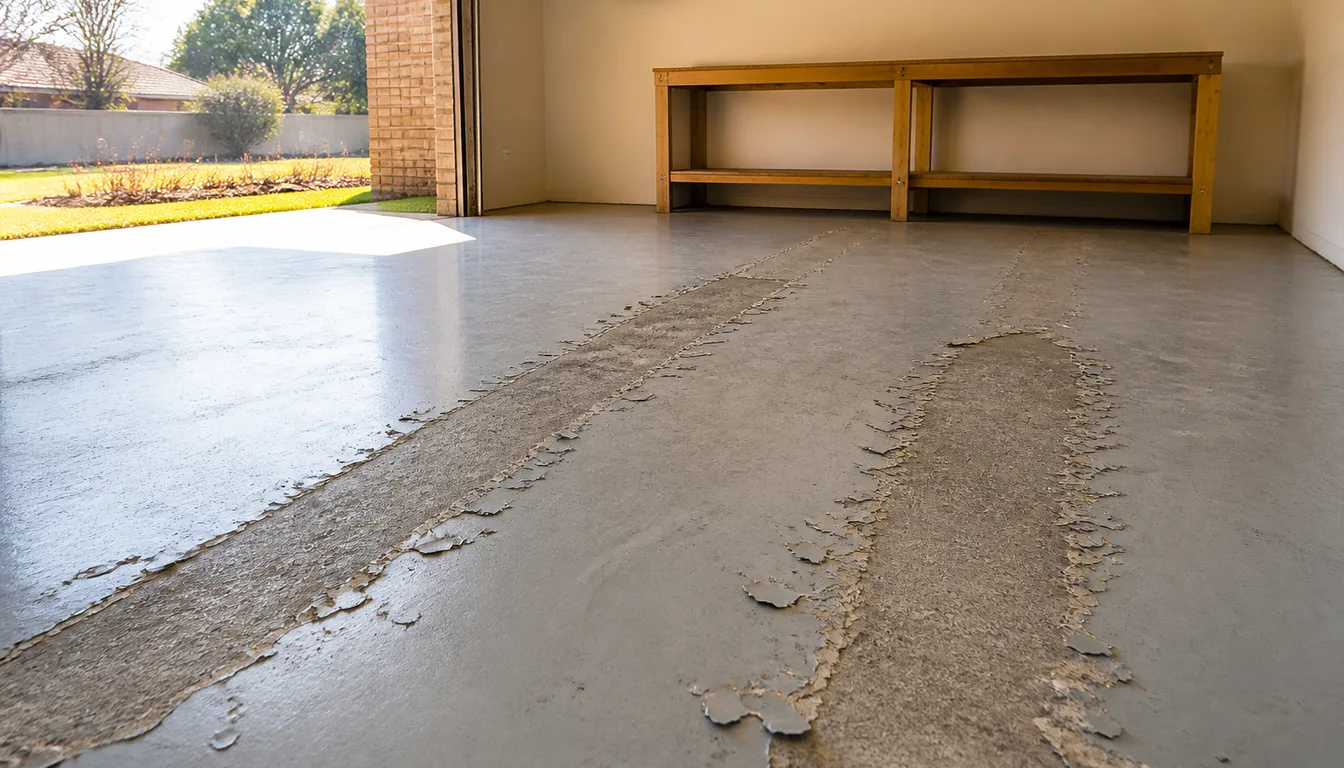
- The slab must be flat. A metallic finish follows every dip in the concrete, so levelling is often part of the price.
- R450–R1,500 per m² is our guide range, the top band of the epoxy systems.
What a metallic floor actually is
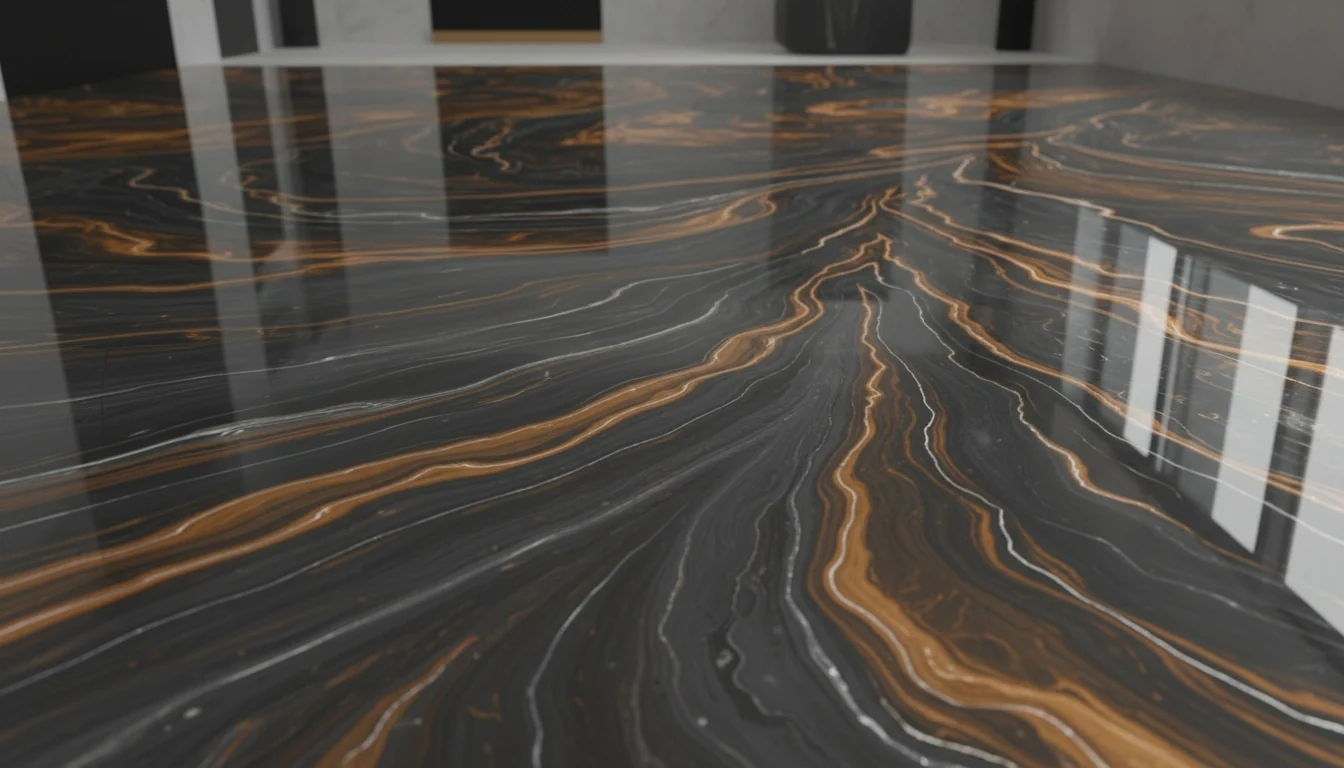
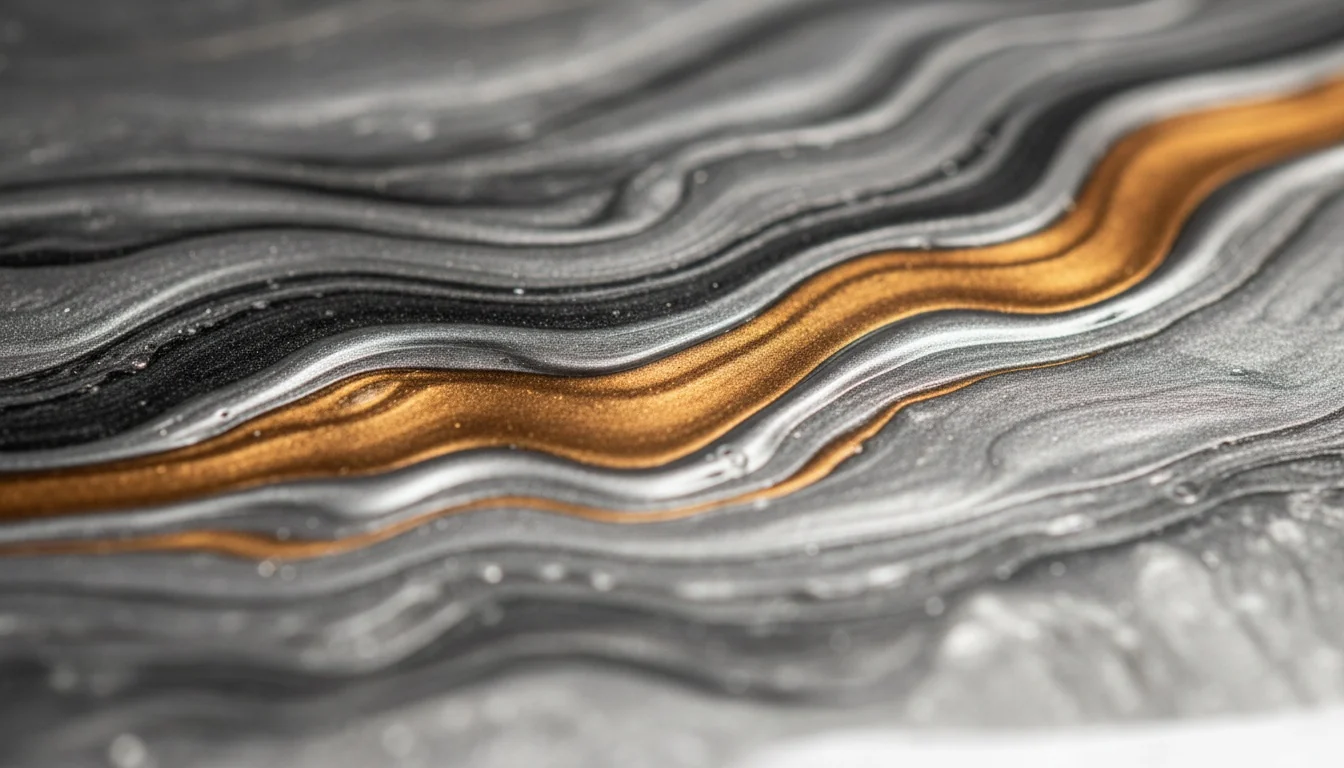
Underneath, it is the same two-part epoxy chemistry as any resin floor. The difference is the pigment: fine metallic mica that reflects and bends light instead of sitting flat like an ordinary colour. As the resin flows, the pigment drifts and gathers, and what sets is a floor with depth, veining and shimmer rather than a single shade.
It goes down over a prepared concrete slab as one continuous surface, so there are no tiles to lift and no grout lines. The metallic finish examples show how much the mood changes with the palette.
How the effect is made
- Level and prime. The same metallic data sheet notes that the finish follows the profile of the concrete and recommends a levelling compound for uneven floors. A dip that would go unnoticed under tiles shows up as a pool of colour under a metallic.
- Base coat. A tinted coat sets the background tone.
- Pour and work the metallic layer. Pigmented resin is poured and moved with rollers, squeegees, moving air or a torch. Coatings writers list a leaf blower and even fingers among the tools; what matters is that it all happens while the resin is still workable.
- Clear coats. Once the design has set, clear coats add depth and gloss and take the wear. Plain epoxy is sensitive to UV, so where sun reaches the floor the final coat should be an aliphatic polyurethane, a type formulated to stop UV reaching and yellowing the epoxy below.

Temperature, timing and the Highveld year
Metallic is more sensitive to conditions than a plain coloured coat, because the look depends on how the resin flows while it is being worked. Here is what the data sheets say, set against Johannesburg's averages.
| Month | Average day high | Average night low | Against a 15 °C minimum |
|---|---|---|---|
| May | 19.6 °C | 7.6 °C | Workable in the warm middle of the day |
| June | 17.3 °C | 4.7 °C | A short window; the room may need warming |
| July | 15.8 °C | 3.5 °C | Only 0.8 °C of headroom on an average day |
| August | 20.1 °C | 6.5 °C | Better by day, still cold overnight while it cures |
| January | 25.5 °C | 14.9 °C | Warm enough, but less working time and humid nights |
Three things follow from that.
Winter: warming the room safely
A cold room can be warmed for the job, but not with the obvious heater. A South African epoxy floor data sheet says not to use gas, oil, paraffin or other fuel-burning heaters, because they give off carbon dioxide and water vapour that can spoil the finish, and to use electric warm-air blowers instead. On a gloss metallic, any clouding of the surface is very visible.
Summer: less time to work the pattern
Heat speeds the chemistry up. On that South African sheet, pot life drops from about 50 minutes at 10 °C to 25 at 20 °C and 15 at 30 °C. The metallic sheet quoted above gives about 30 minutes at 28 °C. That is the whole window for pouring, spreading and shaping the design in each batch, so a hot afternoon leaves noticeably less time than a mild morning.
Storm season: watch the dew point
Both data sheets ask for the slab to be at least 3 °C above the dew point, and the South African one notes that low temperatures with high humidity make blooming (a hazy film on the finish) more likely. In January the average night low at O.R. Tambo is 14.9 °C and the average dew point 14.1 °C, under a degree apart. So on a summer job the slab temperature and dew point are measured on the day rather than assumed. In July, by contrast, the air is dry (average dew point below freezing), and the cold itself is the constraint.
Colours and looks
One pigment over a matching base gives a soft, pearly sheen: think pewter on charcoal or champagne on cream. Two or three contrasting pigments give high drama. Silver and grey read modern; copper and bronze warm a room; blues and greens give depth. The metallic data sheet above rates its light fastness 6 on a scale of 1 to 8, where 8 is best, which is a useful reminder that colour stability is a property to ask about, not assume, for a floor near sunny glass.
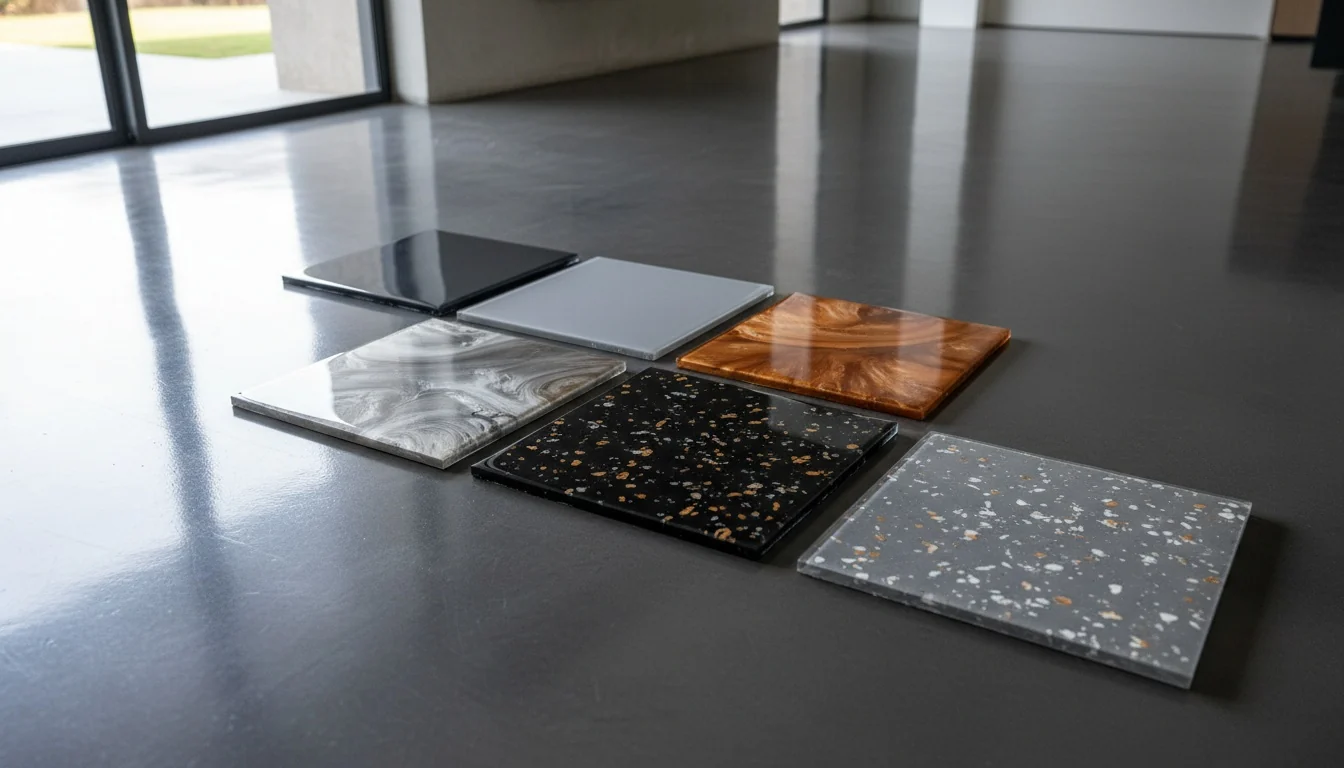
Swatches only go so far with a finish this variable, so we bring sample boards and agree the palette and how bold it should be before any resin is mixed.
Where it works best
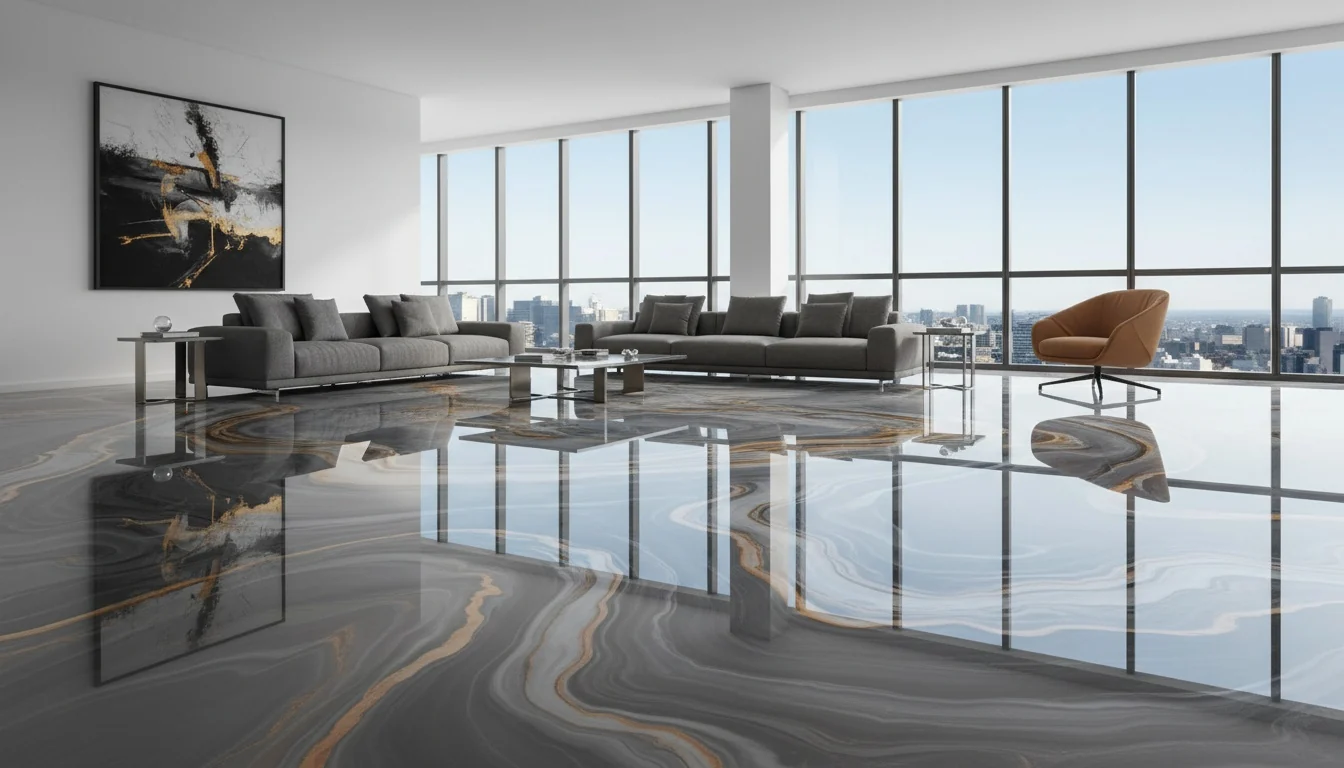
Metallic earns its price in dry rooms where the floor is part of the design:
- Lounges, open-plan living areas and entrance halls
- Showrooms, boutiques and salons
- Offices, receptions and restaurants front-of-house
- A feature garage, where the owner wants a showpiece rather than a workhorse
It is a poor fit for wet, greasy or heavy-wear areas such as commercial kitchens, wash bays and pool surrounds. A gloss surface there needs added grip, and a textured flake or anti-slip system is usually the better choice.
Pros and cons
What you gain
- A floor nobody else has. The pattern cannot be repeated exactly, even by the same hands.
- No joints to clean. A damp mop and a soft broom keep it looking right.
- A hard-wearing surface. The clear coats take the abrasion and stains. For how many years to expect, see how long epoxy floors last.
What it asks of you
- The right conditions. Winter cold and summer humidity both have to be planned for, which can affect your dates.
- A flat, sound slab. Levelling and repairs add to the cost on uneven floors.
- Professional application. The metallic data sheet itself says the product is intended for professional applicators. Short working time and freehand design leave little room for a first attempt.
- Grip in wet areas. Smooth gloss needs an anti-slip clear coat anywhere water is expected.
What it costs in Johannesburg
Our guide range for metallic is R450 to R1,500 per m², the highest band on our epoxy flooring price guide. The low end is a single-pigment design on a slab that needs little work. The high end is a multi-colour feature floor with levelling, repairs and several clear coats, including a UV-stable top coat for a sunny room. Because the slab's flatness and the season both affect the work, a firm price comes from seeing the floor.
Is metallic epoxy worth it?
If the room is dry and you want the floor to be the thing people notice, yes. Nothing else gives the same depth in a single seamless surface. If you need a tough, practical floor for a busy garage or workshop, solid colour or flake does that for less money. To compare systems side by side, our epoxy flooring services pages set metallic against flake, solid colour and industrial finishes. When you are ready, we will bring sample boards, check your slab and give you a written price at no cost.