
A good epoxy floor outlasts most of the things people worry about, but not all of them, and in Johannesburg two of the things that age a floor fastest are seasonal. From December to February the average UV index at O.R. Tambo is 14, strong enough to discolour plain epoxy that sits in the sun. From June to August there are barely two rain days across the three months, and the dry grit that settles on every surface acts like sandpaper underfoot. Neither one ruins a floor that was specified for it. Both shorten the life of one that was not.
Below are the honest year ranges by type of floor, the numbers on a real South African data sheet that tell you how tough a coating is, the faults that end a floor early, and the habits that keep one going.
Key takeaways
- Budget for roughly 10–20 years in a home and 5–10 years on a busy commercial or industrial floor. These are planning figures, not promises.
- Most early failures start underneath the coating: unground concrete, untreated cracks, damp, or contamination on the slab.
- In Johannesburg, summer sun and winter grit do the slow damage. A UV-stable top coat handles the first; regular sweeping handles the second.
- A dull or scratched floor is usually a recoat, not a replacement.
Two kinds of "worn out"
It helps to split lifespan in two. There is the bond: whether the coating stays stuck to the concrete. And there is the finish: whether it still looks the way it did on handover day. A floor can hold on perfectly for fifteen years while its gloss fades in the walkways after six. The first kind of failure means grinding off and starting again. The second usually means a light sand and a fresh top coat, which costs a fraction of the first.
When someone says their epoxy "only lasted three years", it is worth asking which of the two they mean. Peeling at three years is a preparation fault. A tired-looking surface at three years is wear, and it is fixable.
Realistic lifespan by type of floor
What the floor carries matters more than anything else after preparation. A UK flooring firm puts commercial and industrial floors at 5 to 10 years and says 20 to 30 years is not unusual in homes. We use the more cautious figures below, because they assume an average year of use rather than a gentle one.
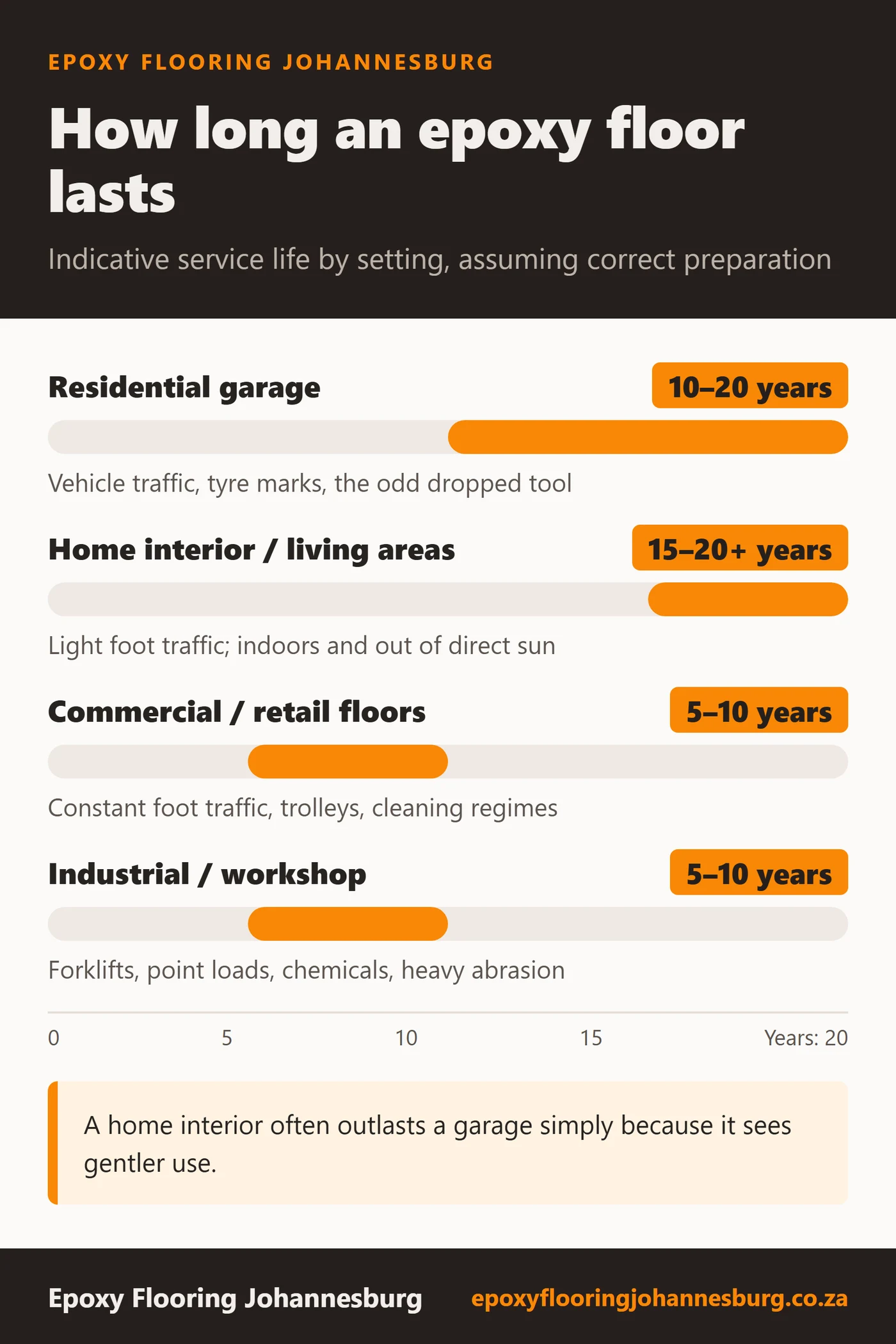
| Where it is used | Indicative lifespan | What wears it |
|---|---|---|
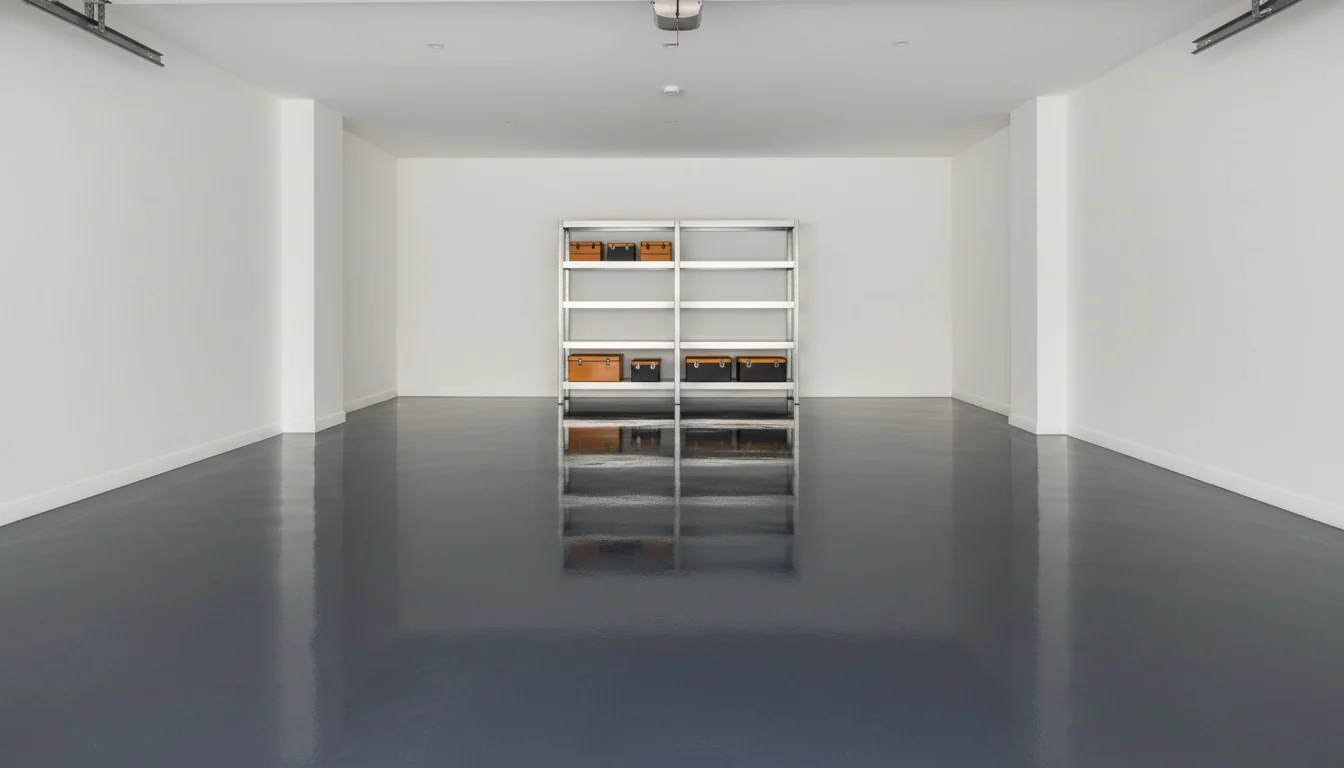
| Residential garage | 10–20 years | Hot tyres, jacks, grit carried in from the driveway |
| Home interior / living areas | 15–20+ years | Shoes and furniture; worst near sunny glass doors |
| Commercial / retail floors | 5–10 years | All-day foot traffic, trolleys, nightly mopping |
| Industrial / workshop | 5–10 years | Pallet jacks, wheel loads, oils and solvents |
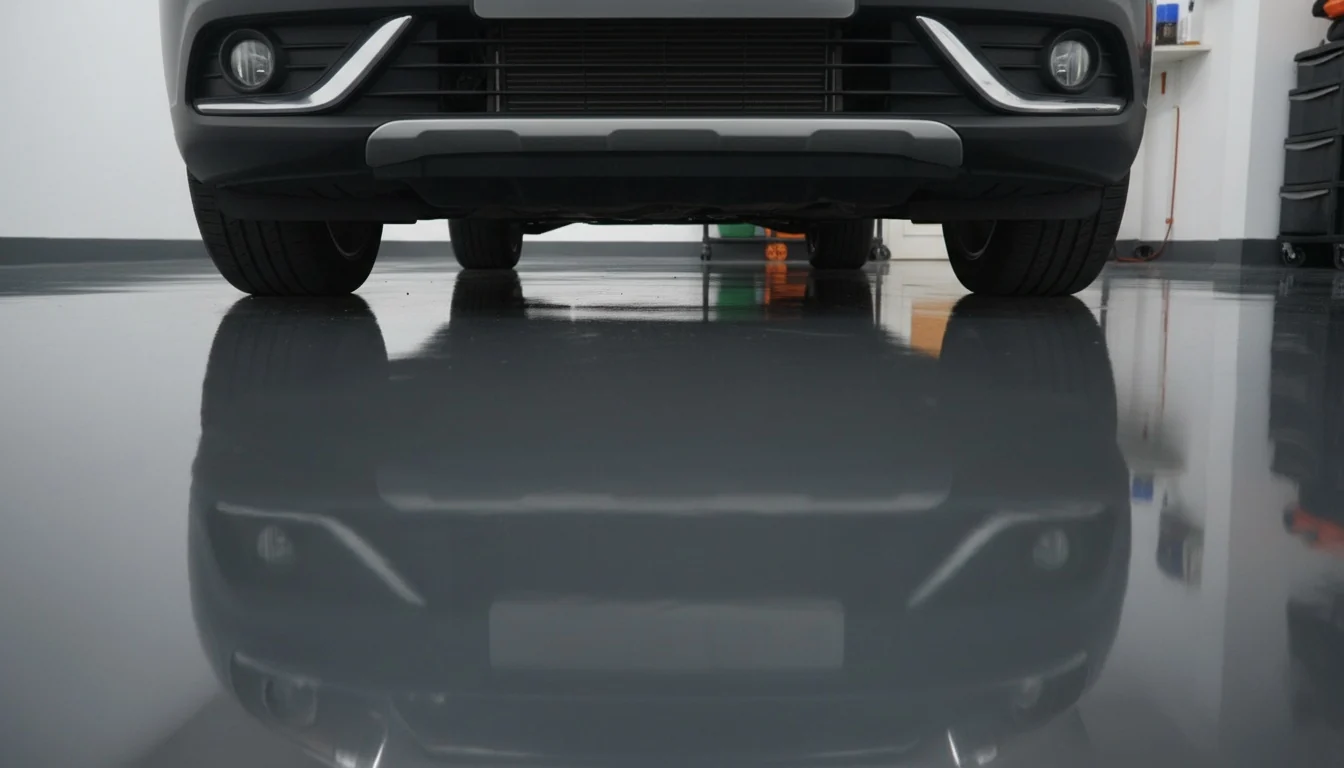
The garage sits below the living room for a simple reason: it is where the heat, the weight and the dirt all arrive together. A garage floor epoxy system built thicker, often with flake or quartz broadcast in, is how that gap is closed.
What a data sheet tells you about toughness
Brochures say "hard-wearing". A product data sheet gives numbers, and they are worth knowing how to read before you compare quotes. Here is what one South African epoxy floor coating data sheet, published in September 2026, lists:
- Taber abrasion: 70 mg. A lab wheel grinds the cured coating for 1,000 turns and the weight lost is recorded. Lower is better. It is a lab figure, but it lets you compare two products on the same test.
- Shore D hardness: 76. A measure of how much the surface resists denting.
- Bond strength: over 1.5 N/mm², with failure in the concrete. In a pull-off test the concrete gave way before the coating let go. That is why a coating can only ever be as sound as the slab under it.
- Interior use only. The same sheet says the product may only be used indoors. A coating applied outside its stated use is a short-life floor before it is even finished, so it is fair to ask which product is going down and what its sheet allows.
The sheet also notes that underfloor heating combined with heavy point loads can leave dents in the resin. If you have heated floors and heavy furniture, mention it at the quote.
What ends an epoxy floor early
Coating over a slab that was not opened up
Epoxy grips by keying into the concrete. The weak, dusty skin on top of a slab (called laitance) has to be ground off first, or the coating is stuck to something that is itself barely stuck. Skipping the grinder is the most common reason a floor peels in its first year.
Hot tyres on a weak bond
Hot tyre pick-up is when a car drives in, parks, and later leaves with patches of coating stuck to the tread. One coatings supplier traces it to poorly removed laitance, to silicone contamination from tyre-shine spray, and to heat softening the film until it peels as the tyre cools. All three are prep or product problems, which is why a garage needs a properly ground slab and a coating built for vehicles rather than a thin paint.
Cracks that were coated over
The data sheet is blunt about this: wrongly assessed or treated cracks can lead to reflective cracking and a shorter service life. A crack still moving will show straight through a rigid coating, so each one is judged first. Settled cracks are filled; moving ones are cut and treated as joints.
Sun on plain epoxy
The same South African sheet warns that direct sunlight can cause some discolouration and colour variation, while noting that it does not affect how the coating performs. That makes it a looks problem rather than a failure, but on a sunny patio or behind a north-facing sliding door it is the first thing you notice. Johannesburg gets about 3,124 hours of sunshine a year, and the summer UV index averages 14, so a sun-exposed floor here needs a clear aliphatic polyurethane coat over the epoxy. Coatings makers formulate those specifically to stop UV reaching and yellowing an epoxy base.
Thin, single-coat products
A one-coat kit leaves a film so thin that grit wears through it in the traffic lanes, and there is no body coat underneath to fall back on. That is one of the disadvantages of epoxy that is really a disadvantage of buying the cheapest version.
Johannesburg's year, seen from the floor
The Highveld's two seasons wear a floor in different ways. This table is built from the O.R. Tambo climate normals; the right-hand column is what each season means for upkeep.
| Months | Average UV index | Rain days (1 mm or more) | What it does to a floor |
|---|---|---|---|
| December to February | 14 each month | About 31 across the three months | Strongest sun on patios and near glass; wet, gritty tyres and shoes after storms |
| June to August | 5 to 7 | About 2 across the three months | Low sun, but dry air (humidity 46–49% in July and August) and fine dust everywhere |
In practice that means a winter routine built around the broom and a summer one built around the mop, plus a top coat chosen for the sun the floor actually gets.
Scratches and cracks: what to expect
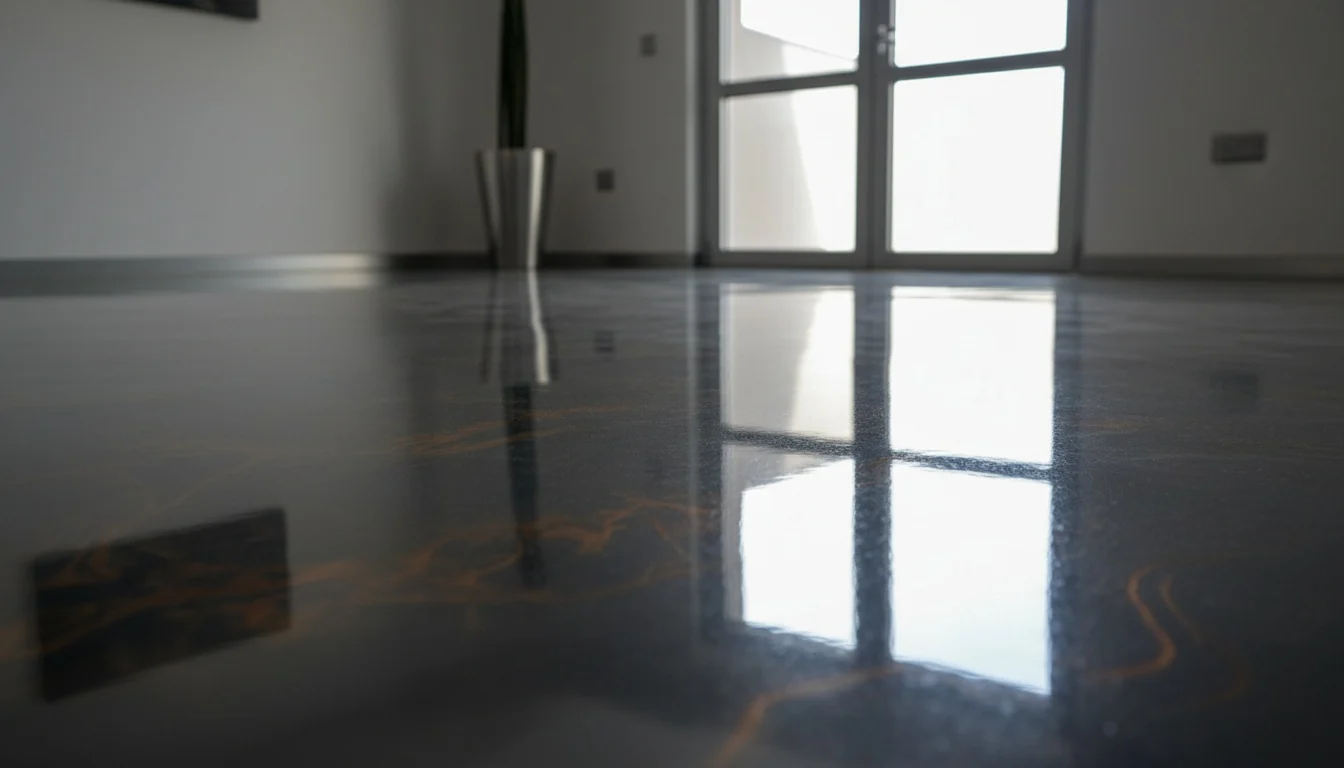
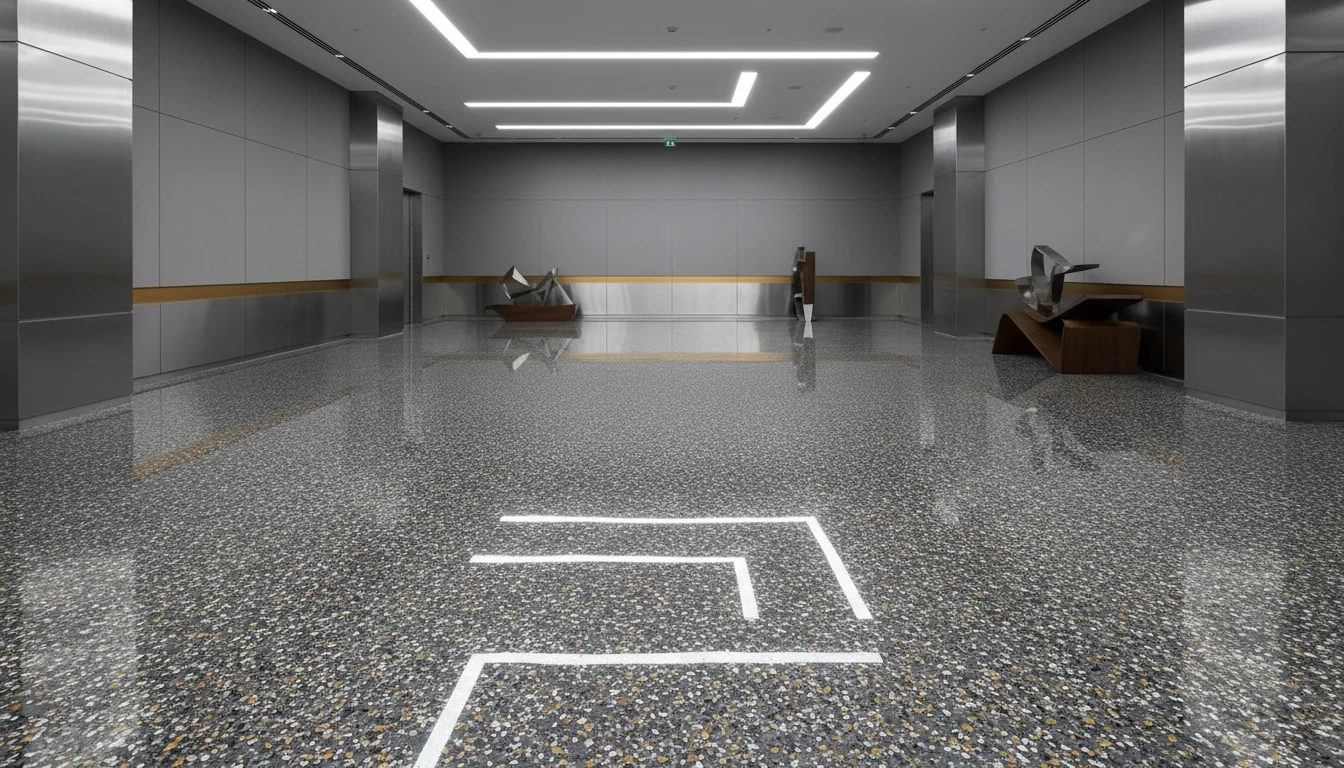
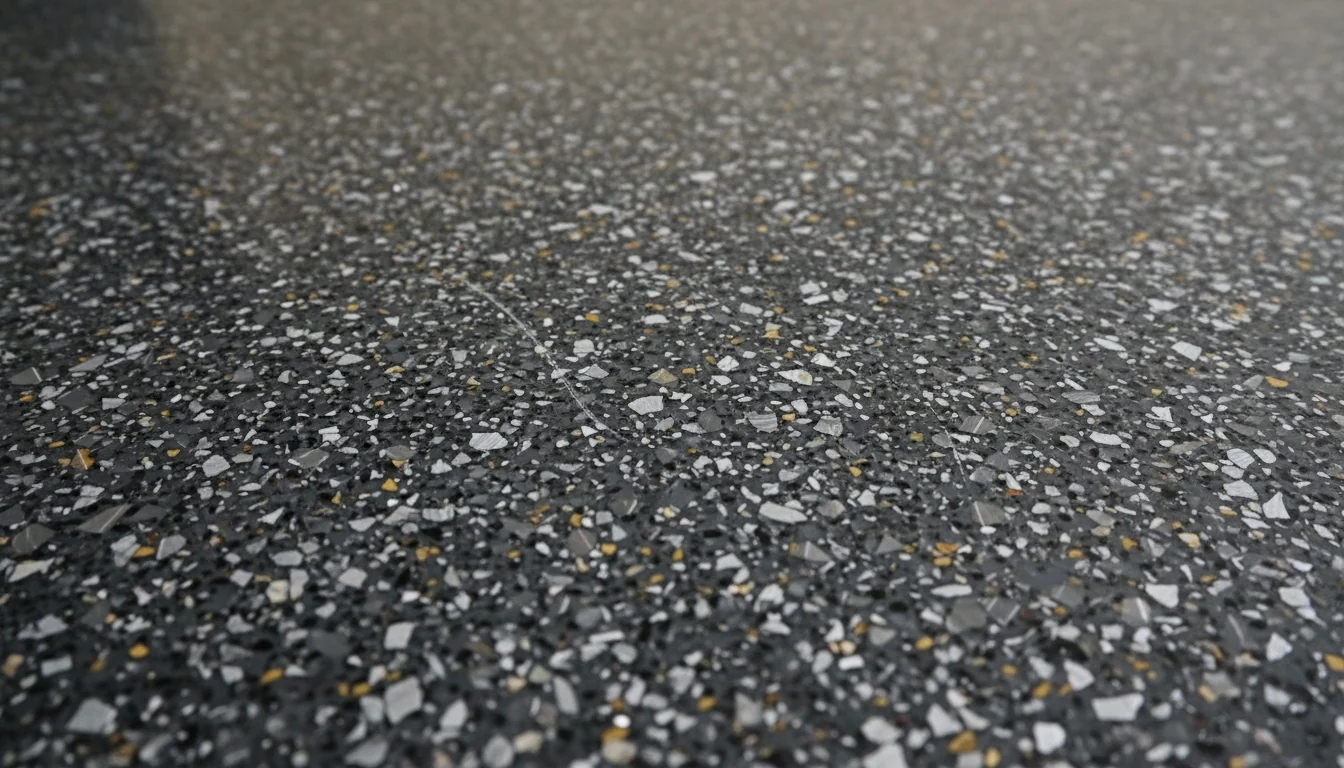
Expect light scratches, and do not expect cracks unless the slab moves. Scratches come from grit under shoes, chair legs without pads, and anything metal dragged rather than lifted. They show most on dark gloss, least on a speckled finish. Have a look at the finish examples if hiding wear matters to you: a flake or quartz blend disguises what a mirror-smooth colour would put on display.
Cracks are a slab story. If the concrete settles or an old crack opens, the coating above it follows. A floor where every crack was dealt with before priming is far less likely to show one later, and if one does appear it can usually be cut out, filled and patched rather than the whole floor redone.
The prep that buys the extra years
The same resin can give a short life or a long one depending on what happens before it goes down. These are the steps that make the difference, and the ones a cut-price quote tends to leave out:
- Grinding the slab with diamonds to remove laitance and open the surface.
- Testing for moisture and choosing a primer that suits the reading.
- Judging every crack and filling or jointing it before the primer.
- Picking a top coat for the light, with a UV-stable layer wherever sun reaches the floor.
We include the grinding, testing and crack work in the price rather than as extras. For a feel of the numbers, our pricing guide sets out the R250 to R1,500 per m² range by system.
Habits that add years
- Sweep more in winter. June to August brings dust and almost no rain to rinse it away. Grit left on the floor is what dulls the traffic lanes.
- Clear spills straight away. The data sheet's own maintenance note asks for spillages to be removed immediately, and oil or solvent left to sit on a garage floor is where staining starts.
- Pad the legs. Felt under furniture and a board under jack stands spread the load.
- Lift, do not drag. Steel toolboxes and shelving scratch even a hard coating.
- Recoat early. A new top coat while the floor is merely dull is cheaper than waiting until the wear reaches the colour layer.
If the floor is in a wet spot, think about grip at the same time as durability; the guide to non-slip finishes covers how texture is added and what it costs you in cleaning.
The short answer
A properly prepared epoxy floor should give a home ten to twenty years and a hard-working commercial floor five to ten. In Johannesburg, plan for the summer sun with the right top coat and for the winter dust with a broom, and most floors that fail early will have failed at the preparation stage. If you want a floor sized up for your slab, your light and your traffic, ask for a free on-site quote and you will get the system and the price in writing.