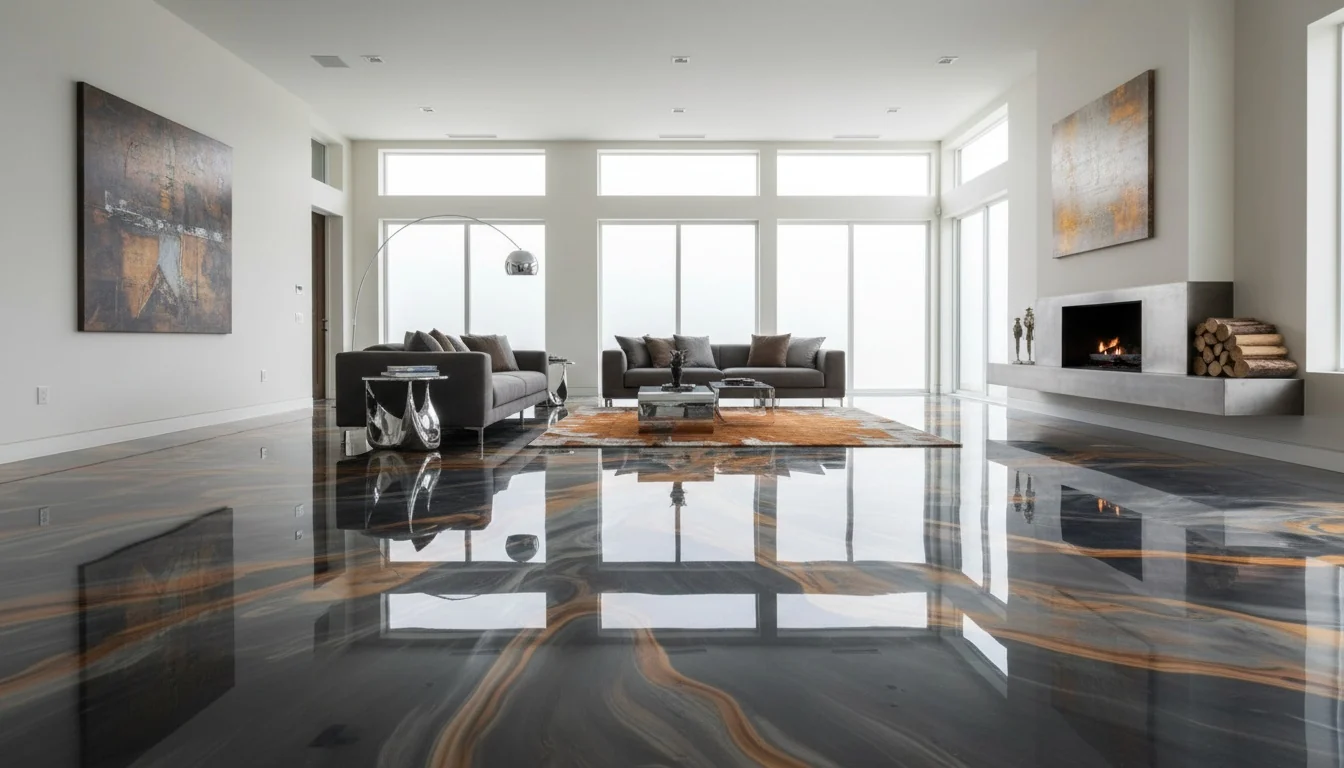
Residential Epoxy Floors for Johannesburg Homes
Sculleries, kitchens, living areas, covered patios and the garage. We check your slab for clay cracks and damp first, then lay a solid-colour, flake or metallic floor one room at a time so the house keeps running.
What sits under a Joburg house decides how the floor turns out
Parts of Gauteng are built on expansive clay that swells when the summer rain soaks in and shrinks again in the dry winter. Housing on that ground is serious enough that the NHBRC recommends a stiffened or cellular raft foundation where the expected heave is more than 15 mm. Researchers studying houses on this kind of clay also found that the north-facing edge of a slab, the side that gets the most sun, goes through the biggest wet-and-dry swings, so that is the side of the house we look at most closely.
A coating cannot stop a slab from moving, so we look at every crack before we price anything. A settled, static crack is filled and coated over. One that still opens and closes with the seasons is cut and detailed as a joint, otherwise it will show through the new floor within a season or two. And because about a quarter of Gauteng sits on dolomite, a crack that is growing, stepping or sinking is a question for a structural engineer first. We will tell you plainly if that is what we see.
Once the slab is sorted, the choice is about looks and use. Solid colour suits a scullery or laundry. Flake gives grip and hides wear in a kitchen or passage. A poured metallic floor makes an open-plan living area the feature of the house. If you are weighing it against tiles, our comparison of epoxy and tiles for Johannesburg homes sets out the trade-offs.
Four things that matter in a Johannesburg home
Winter heaters and a curing floor
A South African epoxy data sheet says to keep gas, oil and paraffin heaters away while the floor cures, because their carbon dioxide and water vapour can spoil the finish. If a July room needs warming, it is an electric blower or nothing.
Afternoon storms and the patio
Johannesburg gets regular afternoon thunderstorms from November to March, and fresh epoxy has to stay dry for at least a day. Covered patios and entrances are booked around the forecast, with anti-slip added where rain blows in.
Underfloor heating
Heated slabs can be coated, but underfloor heating plus a heavy point load can dent the resin. We ask what furniture will stand where and suggest the build to suit.
Kids, dogs and dust
Dust, paw prints and spills sit on a sealed floor with no grout to trap them, so a damp mop does the job. Anti-slip texture is there if the dog skids.
Sources: Bester & Snyman, raft foundations on expansive soils (TUT) · Daily Maverick (2022), sinkholes and dolomitic land in Gauteng · Epoxy floor coating product data sheet, South Africa (Sept 2026) · Johannesburg climate (Wikipedia).
Residential epoxy pricing in Johannesburg
For a home floor, budget roughly R250 to R1,500 per m². Where you land depends mostly on the finish: solid colour at the low end, flake in the middle, metallic at the top.
The slab is the other half. Clay cracks that need cutting and filling, old tiles that must come up, or a damp floor that needs a moisture-tolerant primer all add to the coating rate, and each of those is listed as its own line in your quote. Grinding, primer, the coats and the topcoat are all included in the per-m² figure. The epoxy flooring price guide shows every system's band side by side.
A home floor, step by step
Site visit and crack check
We measure each room, test for moisture, map the cracks and decide which are static and which are still moving, then quote room by room.
Grind and repair
The floor is diamond-ground with dust extraction, static cracks are filled, live ones are cut as joints, and the primer goes on.
Lay the finish
Colour coats, then flake or metallic if you chose them, then a clear topcoat. Anti-slip goes into that topcoat wherever floors get wet.
Let it cure
Around a day before socks and shoes in mild weather, nearer three in a cold room. Heavy furniture waits about a week, longer in winter.
Home epoxy floors across Johannesburg
Site visits are free anywhere in the city. Three suburbs with their own pages:
Epoxy floors at home: your questions
Cost, rooms, pets, tiles, winter and underfloor heating.
Thinking about a floor at home?
Book a free site visit. We will check the slab, talk through finishes room by room and give you a fixed price. If the garage is first on the list, see our garage floor coatings, or go back to the Johannesburg epoxy flooring overview to compare every system.