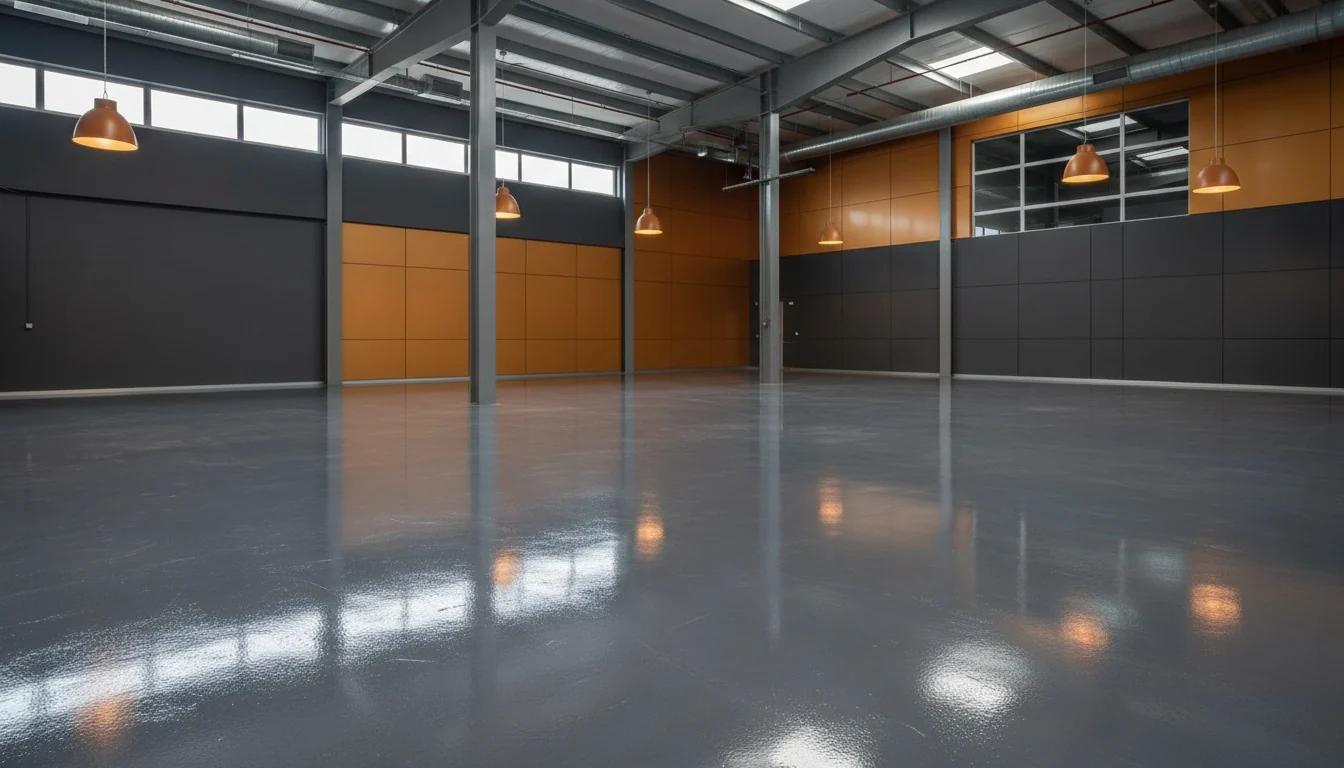
Epoxy Flooring in Midrand
Forklift-rated warehouse floors, line marking, corporate-park showrooms and estate garages for Midrand, Waterfall and Kyalami — installed by our appointed installation team. Free on-site quote.
Epoxy flooring built for Midrand's warehouses and business parks
We install epoxy flooring in Midrand for the kind of floors this part of Gauteng is full of: distribution warehouses, light-industrial units, corporate-park offices and showrooms, and the garages of its newer residential estates. Midrand sits on the N1 halfway between Johannesburg and Pretoria, and that position has drawn warehousing and distribution to it — the Waterfall Logistics Precinct sits right by the highway, and Waterfall City is home to the Mall of Africa.
Floors here are bought for performance first. A distribution floor has to carry racking, take pallet jacks and forklifts all shift long, and stay easy to sweep and mark out. An industrial and commercial epoxy floor is specified to that load, zone by zone, rather than one coat of the same thing laid everywhere. We carry out the on-site assessment, choose the system and install it.
Midrand is not only warehouses, either. Homes in Carlswald, Noordwyk, Blue Hills and around Kyalami have garages that need a tougher floor than bare concrete, and the office parks want floors that look sharp at reception. This page covers all three.
Epoxy systems we install in Midrand
Four systems cover almost every Midrand floor. Prices are indicative, installed, per square metre.
| System | Best for in Midrand | Indicative price | Typical return to use |
|---|---|---|---|
| Industrial / self-levelling | Warehouse aisles, distribution floors, forklift and pallet-jack routes, workshops | R300 – R800 / m² | Many systems take light traffic within about 24 hours; full load resistance builds over the following days |
| Solid-colour epoxy | Storerooms, plant rooms, estate garages and utility spaces | R250 – R400 / m² | Walk on after about 24 hours; vehicles after roughly five to seven days |
| Epoxy flake | Home garages, staff canteens, change rooms and wash areas | R350 – R1,200 / m² | Walk on after about 24 hours; vehicles after roughly five to seven days |
| Metallic epoxy | Corporate-park showrooms, receptions and feature rooms | R450 – R1,500 / m² | Light foot traffic after roughly 24–48 hours; full cure over the following week |
Guide prices only — the firm figure comes from measuring your floor and checking the concrete. Return-to-use times assume normal weather; cold slabs take longer.
What epoxy flooring costs in Midrand
Across all systems, epoxy flooring costs roughly R250–R1,500 per m² installed. Where a Midrand job lands in that range depends on a handful of things, and on a commercial floor they are different from the ones that drive a garage price.
- Size of the continuous area. A large warehouse floor often carries a better per-m² rate than a small one, because setup and mobilisation are spread across more square metres.
- Traffic rating and build-up. A forklift route needs a thicker system than a storeroom, and that is what moves an industrial floor around its R300–R800/m² band.
- Slab condition. Oil-soaked bays, broken joints and old failing coatings all add preparation before any resin goes down.
- How the site has to run. Phased or after-hours work, line marking and anti-slip zones are priced in at the quote, so they don't turn into extras later.
For the per-system detail, and what a typical garage comes to, see our full price guide. The epoxy floor cost for your Midrand site comes from a free on-site measure, not a phone estimate.
Warehouse and industrial epoxy flooring in Midrand
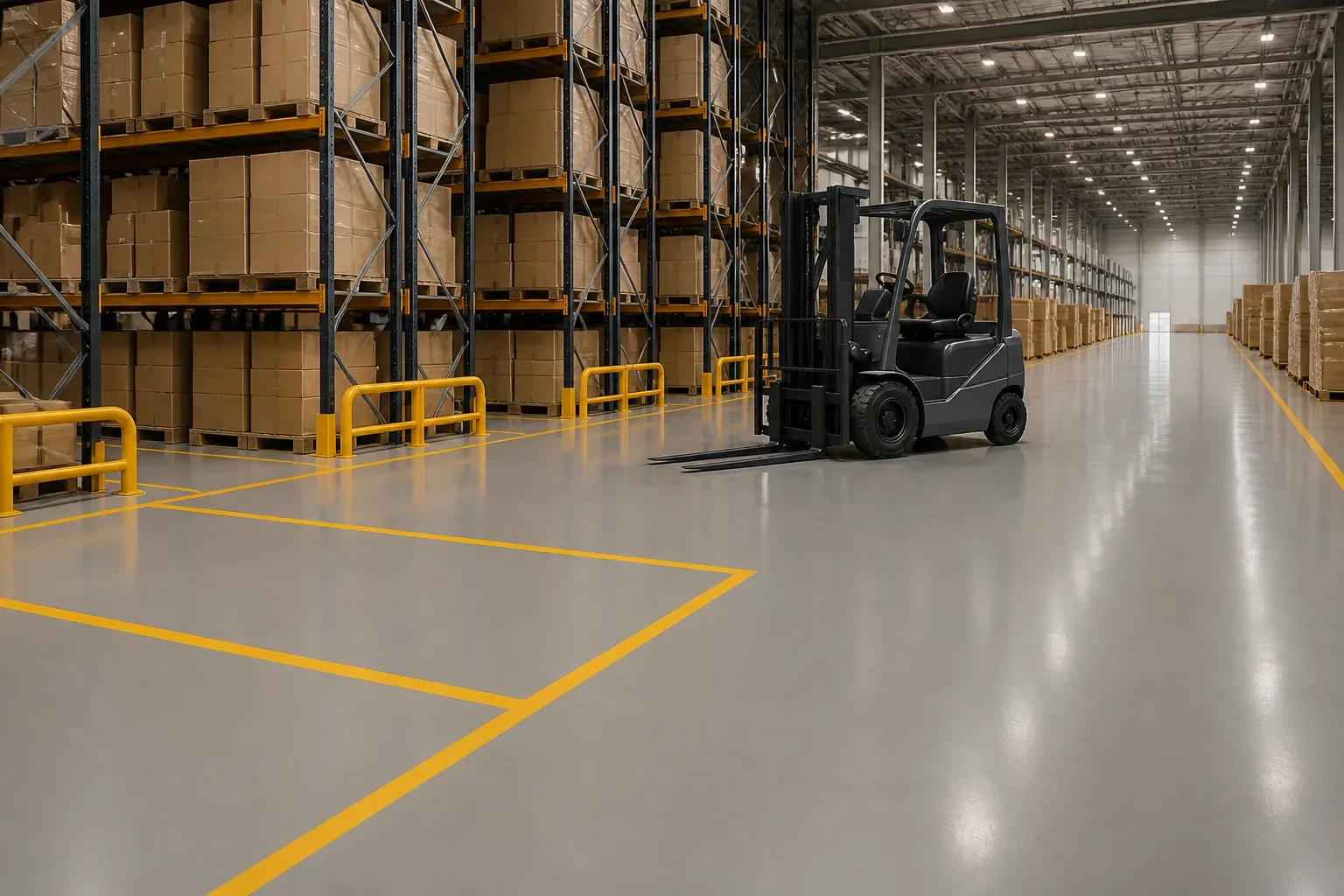
Racking aisles and forklift routes
Forklift tyres turning on the spot are what destroy a thin coating. Aisles, turning points and dock approaches get the heaviest build, and racking feet sit on a floor that has been ground and repaired, not coated over dust.
Line marking and demarcation
Aisle lines, pedestrian walkways, crossings, bay numbers and keep-clear zones around racking and fire equipment can be applied in the same job, so the floor goes back into service already marked out.
Anti-slip where it matters
Dock thresholds, ramps and wash-down areas get a broadcast aggregate for grip; the long runs between them can stay smooth enough to sweep quickly. If you are weighing up grip, it helps to know how slippery epoxy really is wet and dry.
Chemical and wash-down areas
Production, battery-charging and cleaning areas need a system chosen for what gets spilled on it. Where ordinary epoxy would not hold up, we specify a more resistant system for that zone only.
Showrooms, receptions and offices
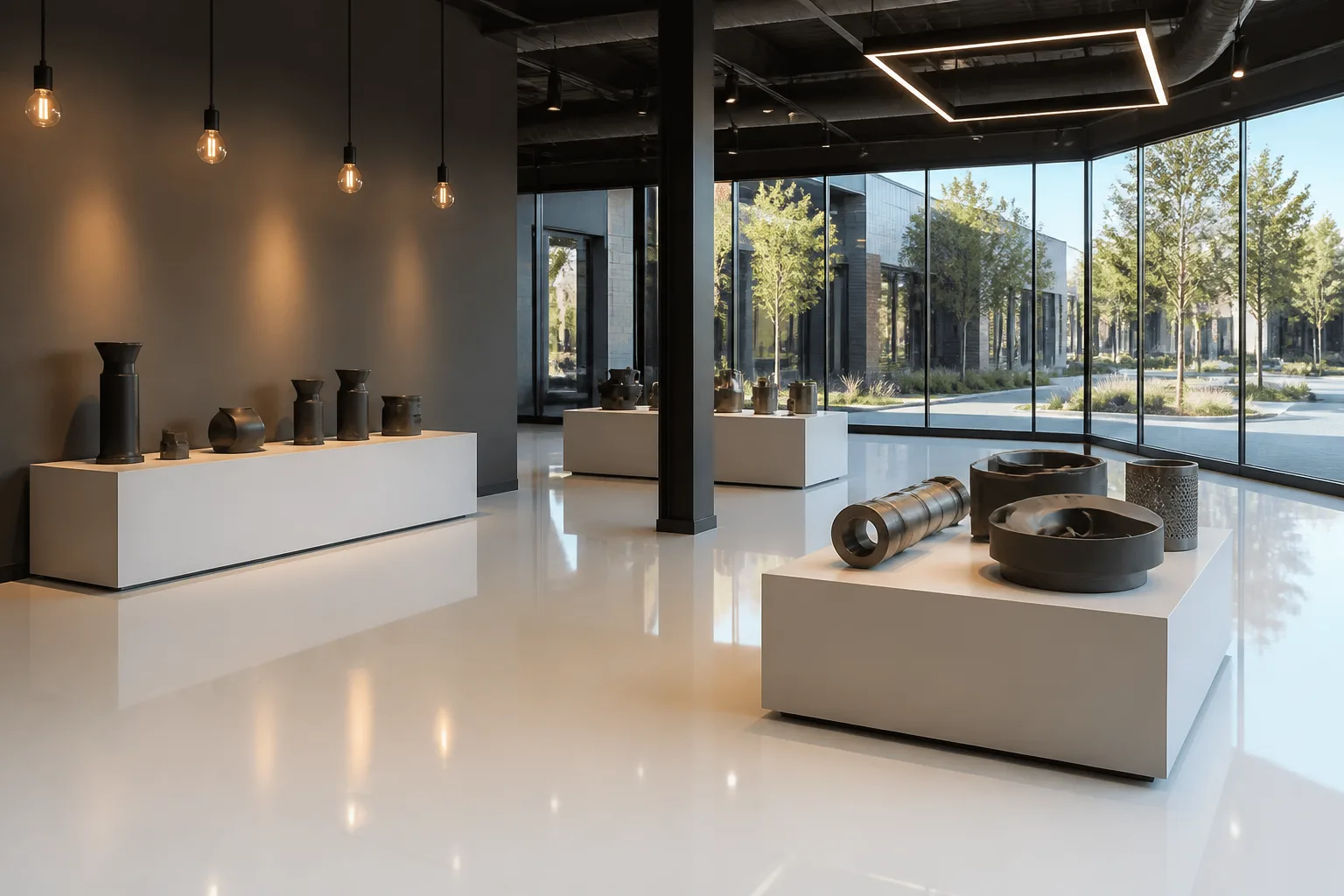
The business parks along the N1 want the opposite of a warehouse floor: a clean, reflective surface that makes a reception or product display look expensive. A seamless solid-colour gloss is the practical choice for a busy entrance, while metallic epoxy gives a showroom a poured, marbled look that tiles cannot give. More looks are in our finishes gallery.
Garage and home floors in Midrand's estates
In Midrand's residential areas — Carlswald, Noordwyk, Blue Hills, Barbeque Downs and around Kyalami — the garage is the floor homeowners most often want coated. Our garage floor coatings start with the same grinding and moisture check as a warehouse, just on a smaller slab: most garages take one to two days of work on site, and you can walk on the floor about a day after the final coat.
A solid colour keeps the cost down; a decorative flake system hides dust and tyre marks better and adds grip. Many estates set work hours and ask for contractor details in advance, so mention your estate when you book and we will arrange access with security before the team arrives.
How we install an epoxy floor in Midrand
The same seven stages apply to a double garage and a distribution floor — on a warehouse they are simply run zone by zone.
- 1
Site inspection and moisture check
We walk the floor, measure it, test the slab for rising moisture and note cracks, oil staining, failed joints or old coatings. On a working site we also map out racking, dock doors and the routes that cannot close.
- 2
Diamond grinding
The surface is ground with dust extraction to remove laitance and open the concrete so the resin can key in. Skipping it is a classic cause of coatings peeling where forklifts turn.
- 3
Crack, joint and pit repair
Cracks and spalled joints are chased out and filled, and pitting is levelled, so the finished floor does not telegraph old damage or trip a pallet jack.
- 4
Primer
A penetrating primer seals the concrete and gives the body coat something to bond to. Where the moisture reading calls for it, a moisture-tolerant primer is specified instead.
- 5
Body coat or self-levelling layer
The main build goes down at the thickness the traffic needs — thicker for forklift routes, lighter for a storeroom — with flake or anti-slip aggregate broadcast into it where specified.
- 6
Topcoat and line marking
A clear or pigmented topcoat seals the surface. Demarcation lines for aisles, walkways, pedestrian crossings and bay numbers go on once the floor is ready to take them.
- 7
Cure and handover
We tell you in writing when the area can take foot traffic, when it can take pallet jacks and forklifts, and how to keep it clean in its first week.
A garage usually takes one to two days of work on site, with walk-on about a day later; a warehouse is scheduled in phases around your operation. For what happens between the first call and the day you drive back in, read how a job runs from quote to handover.
Highveld weather and a Midrand epoxy floor
Strong sun
Standard epoxy is not UV-stable: in direct Highveld sun it ambers and chalks. Dock aprons, covered yards and floors under skylights get a UV-stable polyurethane topcoat over the epoxy so the colour holds.
Cold winter slabs
Clear winter nights leave a large, unheated warehouse slab cold well into the morning, and resin cures more slowly on it. We allow longer between coats in winter and explain how cold slows the cure before you plan your return-to-service date.
Summer storms
Afternoon thunderstorms and hail are part of a Gauteng summer. Work near open dock doors or outdoors is timed for the morning, and fresh coats are protected from wind-blown rain until they have set.
Water-based, solvent-based or solvent-free epoxy?
Three types of resin can all be sold as "epoxy". Here is how they differ on a commercial floor.
Water-based
Thinned with water, low in odour and easy to apply, but it goes on as a thin film. It suits a light-duty storeroom or an office refresh where people are working nearby, not a forklift aisle.
Solvent-based
The solvent helps the resin soak into the concrete, which makes it useful for some primers, but it then evaporates, so the film is thinner than what went down and the fumes need strong ventilation.
Solvent-free (100% solids)
Nothing evaporates, so the full thickness applied stays on the floor. This is the usual choice for warehouse body coats and self-levelling systems. It sets faster in the tin, so it needs an experienced crew.
Choosing the right floor for a Midrand site
Whoever quotes your floor, these questions separate a floor specified for your site from a generic coating:
- Has the slab been moisture-tested, and is the primer chosen from that reading?
- Is the build-up thickness set per zone, with forklift routes heavier than storage areas?
- Is diamond grinding and joint repair written into the quote, not left as an optional extra?
- Are line marking, anti-slip zones and any UV-stable topcoat priced in from the start?
- Is there a written sequence showing which areas close, for how long, and when traffic can return?
- Is the resin solvent-free where the floor takes heavy traffic?
Epoxy is not the answer for every floor, and it is worth reading the honest pros and cons of epoxy before deciding.
Epoxy flooring contractors across Midrand
We come to you for an on-site quote anywhere in Midrand, including:
Near Centurion or Kempton Park? Not sure if we cover your site? Just call 011 018 0264 and ask.
Epoxy flooring beyond Midrand
Got a site elsewhere in Johannesburg? We install epoxy flooring right across the metro, with the same free on-site quotes. Have a look at our other areas:
Midrand epoxy flooring questions
Common questions from Midrand warehouse managers, office tenants and homeowners.
Need an epoxy floor in Midrand?
Warehouse, office, showroom or garage — get a free on-site quote. We'll measure, advise on the right system and give you a firm price.
Serving Midrand and the wider Johannesburg metro. Looking for another part of the city? See our full Johannesburg epoxy flooring service.