
Before anyone signs off on a floor, they usually want the answer to one very practical question: how many days is my garage, my kitchen or my workshop out of action? It is the last thing standing between a quote and a booking, and it deserves a straight answer with real numbers rather than a vague "just a few days".
Here is the short version. You can normally walk on a new epoxy floor about 24 hours after the final coat, and you can park a car on it after roughly five to seven days. Everything interesting sits behind those two numbers: why they move, what makes them longer on a frosty Highveld winter morning or during a summer storm, and what you can safely do with the room in between.
Key takeaways
- Drying and curing are different things. The floor stops feeling wet long before it is strong enough to be used.
- Walk on it after about 24 hours. Park on it after about five to seven days. Those are the numbers we work to on a normal Johannesburg job.
- Temperature moves everything. Published manufacturer schedules show full cure taking around seven days at 20 °C and about ten days at 10 °C for the same coating.
- Cold and damp are different seasons here, and both slow a cure. Johannesburg winter mornings can be cold enough to frost; summer thunderstorms bring the humidity and condensation risk instead.
- The clock does not start at the first coat. It starts at the last one, and there are minimum and maximum waiting times between coats that cannot be skipped.
Drying is not curing, and the difference is the whole answer
Epoxy does not dry the way paint dries. Paint dries by losing its solvent or water into the air. Epoxy is two liquids that, once mixed, react with each other chemically and turn into a solid. Nothing evaporates. The floor gets progressively harder as that reaction runs, and the reaction keeps running for days after the surface already looks and feels finished.
That is why there is no single "dry time" to quote you. There are three separate milestones, and they arrive days apart:
- Touch dry. The surface is no longer tacky. Sika puts this at around eight hours at 20 °C for its garage epoxy. It means nothing about whether you can use the floor.
- Foot traffic. Hard enough to walk on without leaving marks. Roughly 24 hours at 20 °C.
- Full cure. The resin has reached its final hardness, chemical resistance and load capacity. About a week at 20 °C. This is the point at which a car can go back in.
A floor that is touch dry and a floor that is cured look identical. That is precisely why people damage new floors: everything about the surface says it is finished. Standing a jack stand or a loaded toolbox on a floor that has not fully hardened can press permanent marks into it. Sika's own data sheet warns that high ambient temperatures combined with high point loading may lead to imprints in the resin. There is no polishing that out afterwards.
When can you walk on it, and when can you park on it?
Here is what three published manufacturer curing schedules give for a standard epoxy floor coating, measured from the moment the final coat goes down. The ranges show where the three products differ.
| Floor and air temperature | Walk on it | Light use | Fully cured |
|---|---|---|---|
| 10 °C — a cool Highveld winter midday | 24–30 hours | 3–5 days | ~10 days |
| 20 °C — a mild Johannesburg day | 12–24 hours | 2–3 days | ~7 days |
| 30 °C — a hot summer afternoon | 8–16 hours | 1–2 days | 4–5 days |
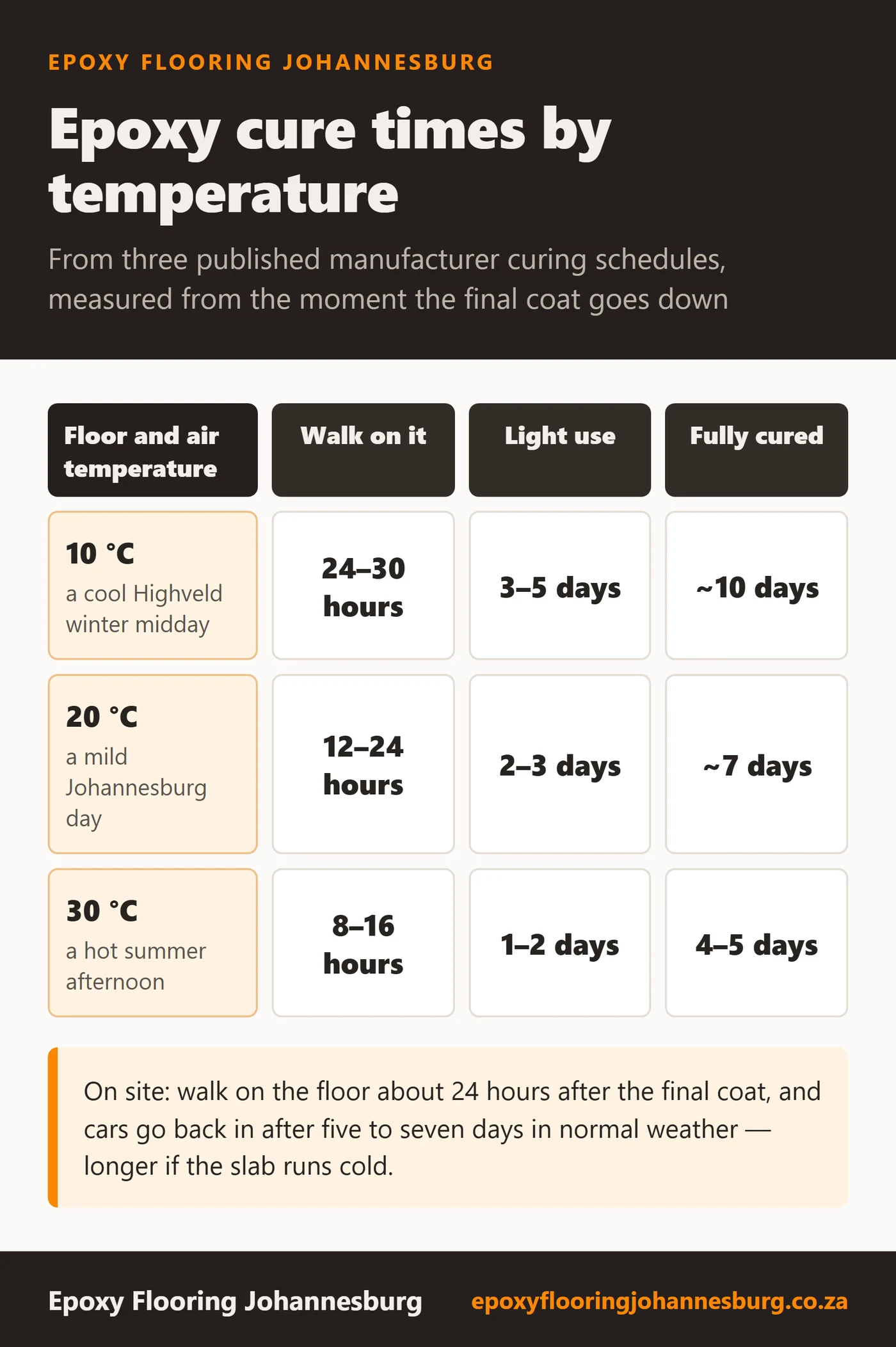
Against that, here is what we commit to on site. You can walk on your floor about 24 hours after the final coat — the cautious end of the published walk-on range. Cars go back in after five to seven days on a normal Johannesburg job, which lines up with full cure on a mild day. If your job runs through a cold spell, we will tell you at handover to allow up to ten days instead. That caution is deliberate. Manufacturer figures are produced in a laboratory at a controlled temperature, and your garage is not a laboratory. The concrete slab holds cold overnight far longer than the air does, and it is the slab temperature that drives the reaction.
Vehicles get the longest wait for a reason. A car is the heaviest load most floors ever carry, and hot tyres are the single harshest thing a garage coating faces. That is the one deadline worth respecting to the day rather than the afternoon. If you want the full picture on what makes a garage floor survive years of that treatment, our garage floor epoxy page sets out the build-up we use and what goes into the price.
Why a Johannesburg winter — and a Johannesburg summer — both change the numbers
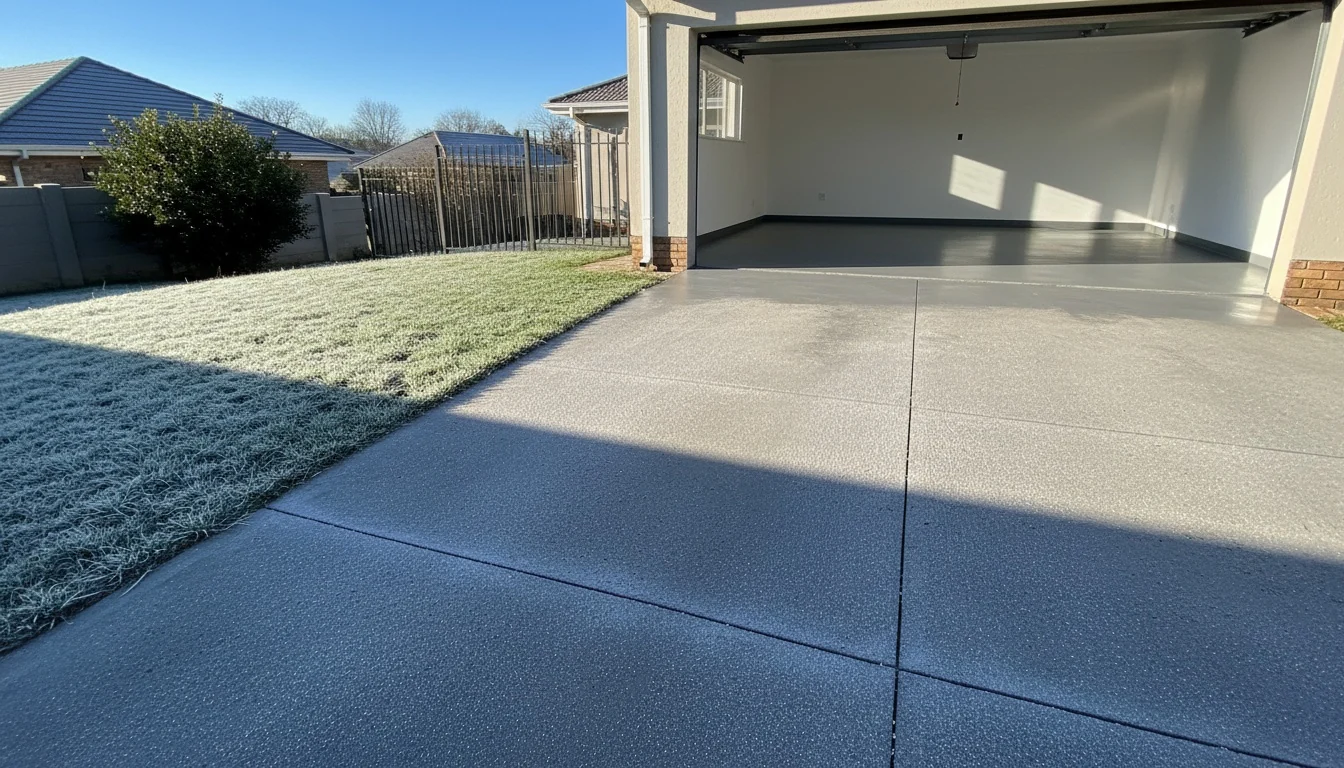
Johannesburg's climate splits cold and wet into two separate seasons, which is worth knowing because it means the two things that slow an epoxy cure show up at different times of year rather than together. The coldest month is July, when the average daily low sits close to 3 °C and the average high only reaches about 17 °C — and because winter skies here are clear and dry, overnight radiative cooling can push a slab colder still, with occasional mornings dropping close to freezing. Compare that with January, the hottest month, when the average high is around 26 °C. The rain, meanwhile, falls the other way round: Johannesburg's wetter season runs mid-October to the end of March, mostly as short, hard afternoon thunderstorms rather than steady drizzle, while the drier season runs from the end of March back through to mid-October — so the cold months and the wet months barely overlap. A garage on the shaded side of a house can easily sit at the bottom of the winter range all morning, and a driveway or patio job can go from bone dry to a downpour in minutes during summer.
Two things follow from that, and both are worth knowing before you book a job in either season.
First, there is a floor below which we will not coat at all. Sika South Africa's data sheet sets a minimum substrate and ambient temperature of +10 °C for its epoxy floor coating, and a maximum of +30 °C. That is a condition of use, not a suggestion. On a Johannesburg winter morning the slab is very often below that minimum before the sun has been on it for a few hours, so winter jobs get scheduled around midday rather than a dawn start. If your slab is sitting under 10 °C, the honest answer is that we wait for it to warm up or come back on a better day.
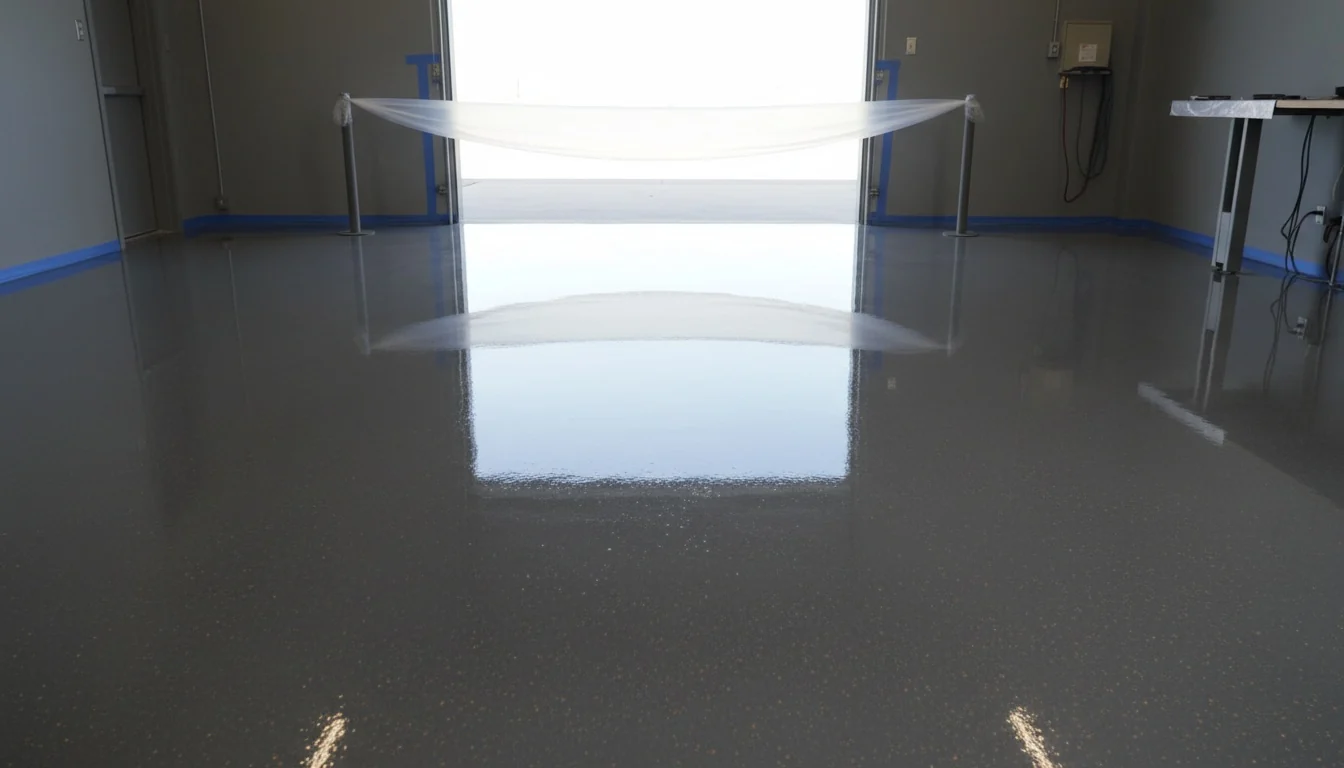
Second, damp does more damage than cold, and here it arrives in summer. The same data sheet caps relative humidity at 80% and requires the substrate and uncured floor to be at least 3 °C above the dew point, to reduce the risk of condensation or blooming on the floor finish. It notes plainly that low temperatures and high humidity conditions increase the probability of blooming. In practice that means a fresh coat needs protecting from damp, condensation and water contact for at least the first 24 hours, and Sika asks for 72 hours on its garage system to prevent white staining and loss of gloss. Johannesburg's dry winter air is actually kind to a curing floor on that front — it is the wet summer months, and specifically an afternoon thunderstorm rolling in on an exposed or partly protected job, that create the humidity and rain-contact risk. We plan around the forecast in both seasons, for opposite reasons: the cold in winter, the storms in summer.
None of this is an argument against a winter or a summer floor. It is an argument for building the extra days into the plan honestly rather than promising the same timeline in July that you'd get in October.
The days before the final coat count too
The cure clock starts at the last coat, but your floor is out of action from the first morning we arrive. A realistic plan has to include the days before that.
Most single or double garages and rooms are prepped and coated over one to two days on site. We diamond-grind the slab to open the concrete, fill cracks and pitting, check for moisture, prime, then build the coats. Decorative metallic floors take longer, usually two to four days, because each clear topcoat has to cure before the next one goes on.
That waiting time between coats is not padding. It has a minimum and a maximum, and both matter. Sika's schedules give a recoat window of 8 to 24 hours at 20 °C, stretching to 16 to 48 hours at 10 °C. Come back too early and the coat underneath is not hard enough to take the next one. Leave it too late and the surface has cured too far for the next coat to bond chemically, at which point the floor has to be sanded back to a dull finish before we can carry on. Cold weather widens that window at both ends, which is one more reason a winter job runs longer.
There is one more thing that can add time, and it is worth raising early: a brand new slab. Concrete needs to dry out before anything is coated over it, and the industry rule of thumb is about 28 days of drying for every inch of slab thickness. It is only a rule of thumb, and drying is genuinely unpredictable, which is why the moisture gets measured rather than assumed. If you are coating a newly poured slab, tell us at the quote so we can test it and plan around the real answer.
What you can and cannot do while it cures
The week after handover is where most avoidable damage happens, almost always because the floor looks completely finished. A simple sequence to work to:
- Day 0 to 1. Stay off it entirely. Footprints pressed into a soft coating do not come out, and dust or grit walked onto it gets sealed in permanently.
- Day 1 onwards. Normal walking is fine. Keep pets off if you can, and keep the space ventilated.
- Day 2 to 3. Light use. Light furniture can go back. Do not drag anything across the surface, lift it.
- Through the first week. No vehicles, no heavy shelving, no jack stands or loaded toolboxes standing on small feet. Concentrated point loads are what leave imprints.
- Also through the first week. Keep water off it, do not wash it, and do not put rubber mats or cardboard down on it. Anything that traps moisture against a coating that is still curing risks marking it.
- After full cure. Everything back to normal, including washing down and cleaning products.
A fair warning about that list: cure time genuinely is a downside of resin flooring, and we would rather say so than pretend otherwise. It is one of several trade-offs we set out honestly in our piece on the advantages and disadvantages of epoxy.
How long does a new epoxy floor smell?
This is the question people ask about interior floors rather than garages, and it deserves a careful answer because the marketing around it is misleading.
The odour comes from the chemical reaction itself, not only from solvents. Sherwin-Williams is direct about this: high performance resin floor systems generate odour during the chemical curing process, and that includes solvent-free, zero-VOC formulations. So a product being described as low-odour is a genuine improvement, but it is not the same as no odour at all, and any supplier telling you a resin floor is completely odourless during cure is overselling.
What follows from that is practical rather than alarming. The smell is strongest while the resin is actively curing and fades steadily as the floor hardens, so it tracks the cure timeline above. Ventilation is the fix, and Sherwin-Williams notes that proper airflow management during installation is typically a sufficient solution. For an occupied home we specify low-odour systems, keep the space ventilated, and work room by room so the rest of the house stays comfortable. If someone in the household is sensitive to smells, or there is a baby or an elderly relative at home, say so when we quote and we will phase the job around it.
We are deliberately not putting a number of days on the smell. We have not found a manufacturer figure we are willing to stand behind, and it varies too much with the product, the room and the ventilation to guess at. We will give you a realistic expectation for your specific system at the quote instead.
Getting the floor back sooner
If the downtime is the problem rather than the price, there are three levers worth discussing.
A faster chemistry. Polyaspartic and fast-cure PU topcoats return to service far quicker than standard epoxy. Sherwin-Williams states that one of its polyaspartic coatings can handle foot traffic within six hours of application, with a recoat window of six to 36 hours, and that it enables a faster return to service than typical urethane or epoxy flooring systems. That speed costs more per square metre, so it is worth it when downtime is expensive and not when it is merely inconvenient.
Warmth. Cure rates rise with temperature, so a warmer room finishes sooner. If a space needs heating we use electric warm-air blowers only. Gas, paraffin and other fossil-fuel heaters produce large quantities of carbon dioxide and water vapour, which can spoil the finish of the floor they were brought in to help.
Sequencing. For a business, the answer is usually not a faster floor but a smarter order of work. We phase commercial jobs in sections or after hours so trading keeps moving, and with the fast-cure systems we specify for that work many commercial floors can be back in light service within 24 hours of the final coat. That planning is a standard part of how we scope industrial and commercial floors, where an extra day of closure often costs more than the coating itself.
The bottom line: how many days is the room out of action?
For a typical Johannesburg garage in reasonable weather: one to two days of work on site, walk on it the next day, and park on it after five to seven days. Call it about a week from the morning we arrive to the morning your car goes back in. In the middle of winter, add a few days for the cold; in the middle of summer, expect us to move the date around a thunderstorm rather than the temperature.
One last clarification, because these two questions get mixed up constantly. Everything above is about how long the floor takes to become usable. How long it stays good once it is cured is an entirely separate question, and we have answered it separately in our guide to how durable an epoxy floor is over the years. The short link between the two is that a floor allowed to cure properly is the one that goes the distance. Rushing the cure is a decision you pay for years later.
If you are trying to plan around a specific window, a kitchen before Christmas or a workshop over a quiet week, tell us the dates and we will work backwards from them. We measure on site, look at the slab, check the forecast, and give you a written timeline with a return-to-use date on it rather than a guess. Book your free on-site quote and we will tell you exactly how many days your floor will be out of action.