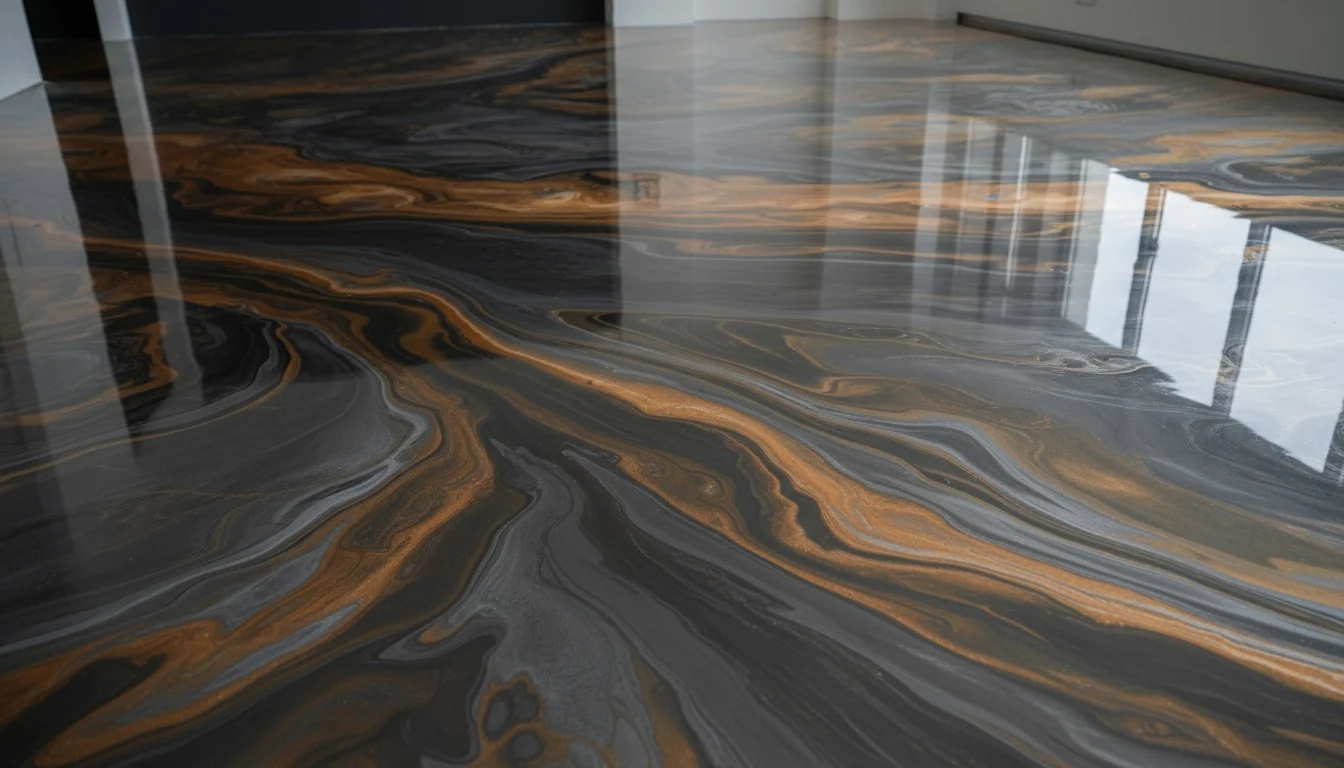
Metallic Epoxy Flooring in Johannesburg
A one-off floor of swirled metal and stone colours, poured and worked by hand in your room. It rewards good timing on the Highveld, so we plan the pour around your slab and the season, and quote it from a free visit.
The pattern is made in minutes
A metallic floor is shaped while the resin is still liquid. Pigment is mixed into a clear epoxy, poured over a tinted base and pushed into veins and pools by roller, trowel and torch. Once the resin starts to set, the pattern is fixed. How long that takes depends on heat: one South African epoxy floor data sheet gives a pot life of about 50 minutes at 10 °C, 25 minutes at 20 °C and 15 minutes at 30 °C.
The air matters as much as the temperature. The same sheet wants the slab at least 3 °C above the dew point and humidity no higher than 80 %, and warns that cold, damp conditions raise the chance of "blooming", a cloudy film that dulls a gloss finish. On a clear coat over a metallic layer, that is the whole look gone. In Johannesburg the summer air is the most humid of the year and the winter slab the coldest, which is why we read both before setting a pour date.
Johannesburg's seasons for a metallic pour
Long-term averages at O.R. Tambo. The dew point is the temperature at which moisture condenses; the slab needs to sit at least 3 °C above it.
| Month | Avg day | Humidity | Dew point | For a metallic floor |
|---|---|---|---|---|
| January | 25.5 °C | 69 % | 14.1 °C | Warm resin works fast and the air is at its most humid. Storm afternoons make timing hard. |
| April | 21.7 °C | 65 % | 9.5 °C | Mild, steadier days and drier air. A good month for a feature floor. |
| July | 15.8 °C | 49 % | −0.5 °C | Dry, but nights near 3.5 °C leave the slab cold. Slow working, long waits between coats. |
| September | 23.6 °C | 47 % | 5.3 °C | Warm days and some of the driest air of the year. Keep doors shut on windy days so dust stays off the wet coat. |
Sources: Epoxy floor coating product data sheet, South Africa (Sept 2026): pot life, recoat window, humidity and dew point · Johannesburg O.R. Tambo climate normals, incl. humidity and dew point.
A feature floor without joints
One of a kind
The pattern forms as the resin moves and sets, so your floor will not match anyone else's, or a sample, exactly.
Colours you choose
Pearl, pewter, copper, charcoal or a mix. You agree the colours from samples before anything is poured.
No grout, no seams
One continuous glossy surface that bounces light around the room and has no lines to collect dirt.
Protected on top
Clear coats over the metallic layer take the scuffs and spills, so the pattern underneath stays intact.
Metallic epoxy pricing in Johannesburg
Metallic is our most decorative system and the top of our price range. The 2026 guide:
- Metallic band: R450 to R1,500 per m²
- One pigment, soft contrast: towards the lower end
- Several pigments, bold contrast: towards the upper end
- Extra clear or UV-stable topcoats: added to the figure
Hand work and the number of layers set most of the price; the condition of the slab sets the rest, and repairs are listed separately in the quote. The epoxy flooring price guide puts metallic next to every other system. If sun reaches the floor through a window or a stacker door, ask about a UV-stable polyurethane topcoat: a South African epoxy data sheet notes that standard epoxy may discolour in direct sunlight.
From bare slab to metallic floor
Grind and base
The slab is ground, repaired and primed, then a tinted base coat goes down to set the background colour.
Pour and work
Pigmented clear resin is poured and moved by roller, trowel and torch inside its working time, which is shorter on a hot day.
Wait, then clear coats
Each layer cures before the next. At 20 °C one data sheet allows a day to two days before recoating; at 10 °C, up to three.
Cure and hand back
Light foot traffic a day or two after the last coat; full cure over the following week, longer in winter.
Metallic epoxy floors across Johannesburg
The design visit is free wherever you are in the city. Three areas with their own page:
Metallic epoxy flooring: your questions
Cost, looks, the best season, upkeep and timing, answered before you book.
Plan your metallic floor
Book a free visit to look at colours, check the slab and get a fixed price with a suggested pour date. Thinking about the rest of the house too? See epoxy floors for the home or every system on the Johannesburg epoxy flooring home page.