Industrial & Commercial Epoxy in Johannesburg
Warehouse aisles, factory floors, food rooms and showrooms from Midrand to the East Rand. We test the slab, specify a system for your loads, heat and wash-down routine, and phase the work so the business keeps running.
Floors for the workshop of the country
Ekurhuleni, the metro on Johannesburg's eastern side that takes in Germiston, Kempton Park, Boksburg and Bedfordview, has been described as “the workshop of the country”. It is also home to OR Tambo, the biggest and busiest airport in Africa. Add the distribution parks along the N1 at Midrand and the factories of the West Rand, and this part of Gauteng has a great many working floors: forklift aisles, loading bays and production rooms.
Those floors fail for different reasons, so they are not all quoted the same way. A showroom or office wants a tough, good-looking coat. A pick-and-pack warehouse needs a thicker self-levelling build that takes pallet trucks without cracking or wearing through in the aisles. A food or beverage plant needs a seamless, coved wash-down floor that satisfies a food-premises inspection. A plating line, battery room or chemical store may need polyurethane or other specialist resins because standard epoxy will not survive the heat or the acids.
We start every one of these jobs on the slab, not with a catalogue. Strength, oil, moisture and joint condition decide the prep and the system before colour or thickness come into it.
A commercial unit, from bare slab to gloss
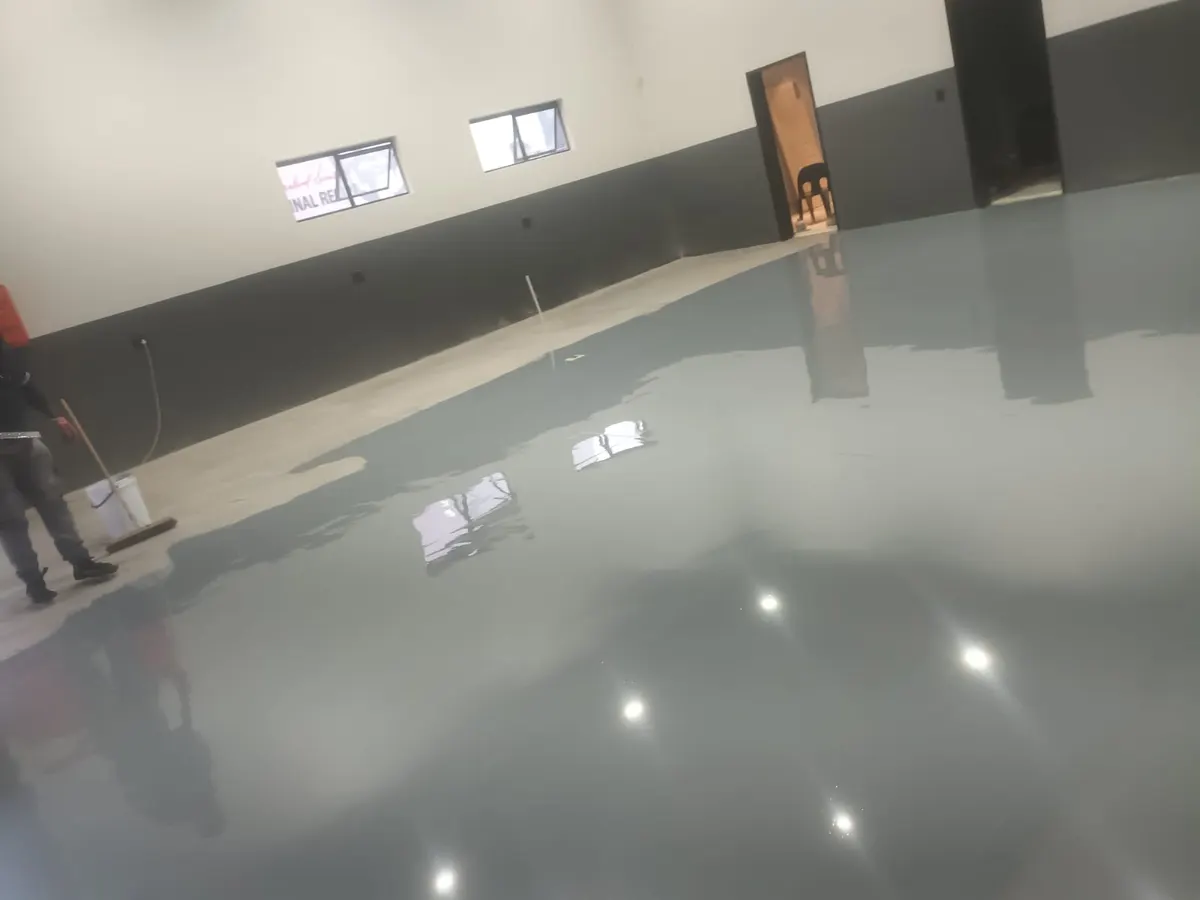
Real photos and phone video from our installation team: the slab prepared, grey self-levelling epoxy spread out to the roller door, and a second job with floor drains set into the finish. Tap any picture to see it full size.
More real jobs, including natural stone restoration, in the epoxy floor gallery.
Three numbers and one regulation
Food premises: R638
South Africa's food-hygiene regulations require floors in food-handling areas to have no open joints or seams and to be smooth, cleanable, non-absorbent, dust-proof and water-resistant. That is why food rooms get a seamless floor with coving, not a coated slab with open saw cuts.
Slab strength: 25 and 1.5
One South African floor-epoxy data sheet wants concrete of at least 25 N/mm² compressive strength and 1.5 N/mm² pull-off strength, with no more than 4% moisture and no rising damp. Old warehouse slabs are tested against those numbers before we quote.
Heat: 50 °C dry, 80 °C occasional
The same sheet rates the coating for 50 °C dry heat all the time and up to 80 °C wet heat only now and then, such as a steam clean. Kitchens, bakeries and wash bays that run hotter or wetter than that get a heat-rated system instead.
Sources: GN R638 (2018), hygiene requirements for food premises · Epoxy floor coating product data sheet, South Africa (Sept 2026) · Ekurhuleni Metropolitan Municipality (Wikipedia).
Built around how the space is used
Aisles that hold up
Thicker self-levelling builds where pallet trucks and forklifts turn, so the wear path does not break through to bare concrete in a year.
Spills stay on top
Hydraulic oil, diesel, cleaning agents and many other chemicals sit on a cured resin floor until they are cleaned up, instead of soaking into the slab.
Wash-down without seams
Coved skirtings and a jointless surface leave nothing for water, grease or bacteria to sit in, which is what the R638 food-hygiene rules ask of a food-handling area.
Grip and clear lanes
Anti-slip aggregate where floors get wet, and painted walkways, forklift lanes and no-go zones set out with your safety officer.
Industrial & commercial epoxy pricing in Johannesburg
Working floors are priced per m² by build thickness and duty. Our 2026 guide:
- Industrial, self-levelling and heavy-duty systems: about R300 to R800 per m²
- Showrooms, offices and dry stores: towards the lower end
- Forklift aisles, thick self-levelling and coved food-room floors: towards the upper end
- Oil removal, weak concrete, joint rebuilds and line-marking: priced as separate lines
A big open floor usually works out cheaper per m² than a small room, because setting up the grinders and extraction is spread over more area. Night or weekend phasing can add to the labour line. The quote covers the slab tests, mechanical prep, primer and every coat. For every system side by side, see the epoxy flooring price guide.
From slab test to handover
Survey and specify
We test moisture and surface strength, map the cracks and joints, and ask about loads, chemicals, temperatures and cleaning. The system and thickness follow from that.
Strip it back
Diamond grinding or shot-blasting takes off oil, old coatings and the weak top skin. Spalled joints and cracks are rebuilt before primer.
Lay it in sections
Primer, body coats or self-levelling build, coving, anti-slip and line-marking, laid one zone at a time so the rest of the site keeps working.
Cure, then load
At 20 °C, roughly a day to foot traffic, about four days to light traffic and about a week to full load and chemicals. Cold winter sheds take longer.
Industrial & commercial floors across Johannesburg
Site surveys are free across Johannesburg and the East and West Rand. Three areas with their own pages:
Industrial and commercial floors: your questions
Cost, food-premises rules, heat, specialist resins, downtime and old slabs.
Get your working floor specified and priced
Book a free site survey. We will test the slab, ask how the floor is used and give you a per-m² price with a phasing plan. For a showroom that has to look good as well as wear well, look at a metallic epoxy finish, or start from the Johannesburg epoxy flooring overview.