
Epoxy Flooring in Fourways
New-build garages, estate patios and retail floors for Lonehill, Dainfern, Broadacres and Cedar Lakes — installed by our appointed installation team. Free on-site quote.
Epoxy flooring for Fourways homes, estates and shops
In Fourways, much of the demand for epoxy flooring comes from new homes. The area has been one of the fastest-developing residential and commercial hubs in the north of Johannesburg, and much of its housing sits in estates such as Dainfern, Cedar Lakes, Cedar Creek and Fourways Gardens, or in newer complexes across Lonehill, Broadacres and Magaliessig. That means a lot of young concrete: garages that have never been sealed, and slabs that still need checking before anything goes on them.
The other half of the picture is retail. Fourways Mall, Montecasino, Design Quarter, Fourways Crossing and Cedar Square pull in shoppers and diners every day, and the shops, showrooms and restaurants around them need floors that stay presentable under that traffic.
We cover both. Below you will find the systems we install here, what they cost, how a job runs, and the local conditions that decide which finish lasts.
Epoxy systems we install in Fourways
The four systems that suit Fourways homes and shops. Prices are indicative, installed, per square metre.
| System | Where it fits in Fourways | Indicative price | When you can use it |
|---|---|---|---|
| Epoxy flake | New-build garages, laundries, covered braai areas | R350 – R1,200 / m² | Walk on after about 24 hours; park after roughly five to seven days |
| Solid-colour epoxy | Budget garages, storerooms, stockrooms behind a shop | R250 – R400 / m² | Walk on after about 24 hours; park after roughly five to seven days |
| Metallic epoxy | Entrance halls, entertainment rooms, boutique and showroom floors | R450 – R1,500 / m² | Light foot traffic after roughly 24–48 hours; full cure over the following week |
| Industrial / self-levelling | Busy retail floors, restaurant back-of-house, workshops | R300 – R800 / m² | Many systems take light traffic within about 24 hours; full strength over the following days |
Indicative guide prices, not a quote. Timings are for normal weather; allow longer in a cold garage.
What an epoxy floor costs in Fourways
A double garage is the easiest Fourways job to put numbers on. At roughly 36 m², a flake floor starts from about R12,600 (36 m² × R350, the bottom of the flake band) — indicative arithmetic, not a quote, and the finish, chip density and slab condition move it up from there. Our price guide puts a double garage from R12,000, depending on the system you choose.
What pushes a Fourways price up or down:
- The finish — solid colour at the bottom, flake in the middle, metallic at the top.
- The state of the slab — builders' residue, paint splashes, cracks or a high moisture reading add preparation.
- Anything in the sun — a UV-stable topcoat on a patio or threshold costs more than plain epoxy, and is worth it.
- Access — a shop that can only close after hours, or an estate with limited work hours, is planned into the price.
The current price bands for every system are set out in full, and the epoxy floor cost for your own Fourways property comes from a free on-site measure.
Garage floor epoxy for Fourways new-builds
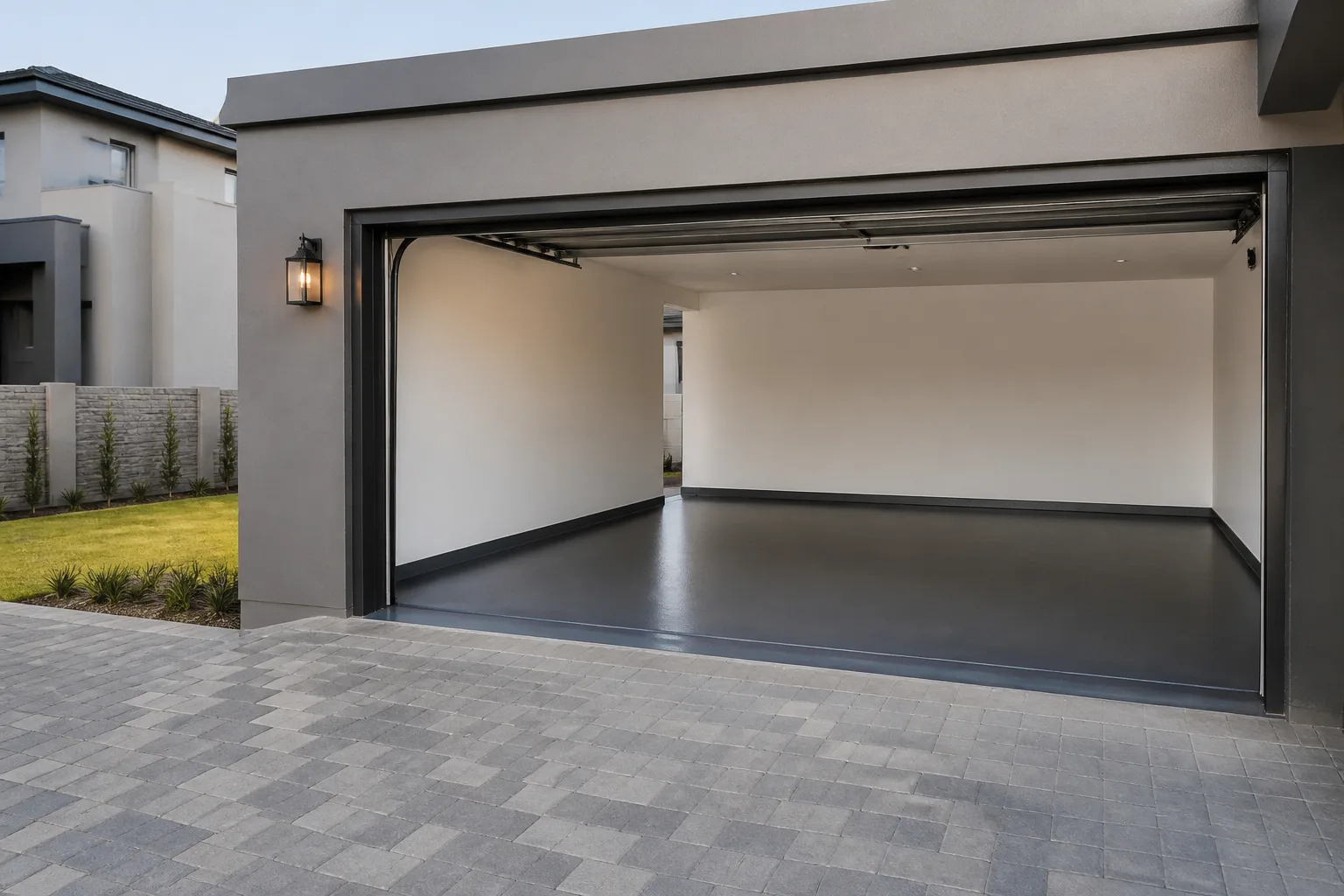
The best time to coat a garage is while the house is new: the space is empty and nothing has stained the concrete yet. The catch is that the slab is young. Fresh concrete keeps giving off moisture for weeks after it is poured, and an epoxy laid over a damp slab can blister or lift. We take a moisture reading at the quote and book the work for when the concrete is ready, rather than guessing from the date the builders left.
For most new-build garages we recommend epoxy on a new garage floor in either a solid colour or a flake-chip broadcast floor, which hides dust and tyre marks well. If you are still weighing it up, we have written about whether a garage is worth coating at all.
Entertainment rooms and entrance halls
Inside the house, a metallic epoxy floor turns an entrance hall or games room into a feature. It is one option among our epoxy finishes for living areas, done room by room so the rest of the house stays usable.
Covered patios and braai areas
Estate patios see sun, spilled drinks and braai fat. They need a UV-stable top layer, and the same thinking applies to coating a driveway or other outdoor slab.
Shop, showroom and restaurant floors in Fourways

Boutiques and showrooms
A seamless floor has no grout lines to trap dirt, and a satin or gloss finish lifts the lighting. Browse the gallery of finish examples for colours.
Restaurant kitchens
Hot oil, boiling water and daily wash-downs break ordinary epoxy. Kitchens get a heat-tolerant polyurethane system specified for exactly that punishment.
Stockrooms and workshops
Back-of-house areas take trolleys and dropped stock. Our commercial-grade systems are built thicker for that abuse.
Trading can carry on: retail floors are usually done after closing time or one section at a time, and we agree the sequence before we start.
Our installation process in Fourways
Here is how a typical Fourways garage or estate floor goes from quote to walk-through.
- 1
Quote visit and moisture reading
We measure the floor, take a moisture reading and look for hairline cracks, curing compound or paint overspray left by the builders — all common on a new-build slab.
- 2
Estate access arranged
Contractor details, vehicle registrations and work hours are sent to your estate or body corporate ahead of time, so the team is not held at the gate.
- 3
Grinding to open the surface
Even a smooth new slab has a weak top skin. Diamond grinding removes it so the coating bonds to sound concrete instead of sitting on top.
- 4
Filling and priming
Cracks, control joints and pinholes are filled, then a primer soaks into the concrete to anchor everything above it.
- 5
Colour coat and flake or metallic layer
The pigmented body coat goes down, with flakes broadcast into it or metallic pigment worked through it, depending on the finish you chose.
- 6
Clear topcoat
A clear sealer locks the finish in and sets the sheen. On anything that sees sun, it is a UV-stable topcoat rather than plain epoxy.
- 7
Cure and walk-through
We walk the finished floor with you and confirm, in writing, when you can walk on it and when the cars can go back in.
Most garages take one to two days of work on site, and you can walk on the floor about a day after the final coat; a metallic room can take two to four days. Our step-by-step installation guide covers the whole process in more detail.
Sun, frost and storms: what the Highveld means for Fourways floors
The garage-door strip
Plain epoxy yellows in sunlight. On a garage that faces the afternoon sun, the strip just inside the door is where it shows first, so we finish that strip, and any patio, with a polyurethane topcoat that stands up to UV.
Cold mornings in winter
On a frosty June morning an unheated garage slab can sit well below the temperature epoxy likes, and the resin cures more slowly on it. Winter work is still fine; the cars just stay out a little longer.
Summer downpours
Afternoon storms and hail bring water and grit to the garage door. We time outdoor coats for the morning and ask that nobody drives wet tyres onto the floor before it has cured.
Water-based vs solvent-based vs 100%-solids epoxy
Two quotes that both say "epoxy garage floor" can be for very different products. For a home, the differences come down to odour, thickness and how long the floor lasts under car tyres.
Water-based epoxy smells least, which matters in a garage attached to a lived-in house. It goes on thin, though, so it is better suited to a light refresh of a storeroom or laundry than to a floor you park on every day.
Solvent-based epoxy soaks well into concrete but gives off strong fumes while the solvent evaporates, and the film shrinks as it does. It is mostly used as a primer, and needs the garage doors open and the family out of the way.
100%-solids (solvent-free) epoxy keeps its full applied thickness because nothing evaporates. It is the choice for a garage that takes hot tyres and dropped tools, and for flake and metallic systems that need a proper build.
Picking the right finish for a Fourways property
- Where does the sun reach? Anything it touches needs a UV-stable topcoat.
- Will cars park on it? Choose a solid-colour or flake system on a solvent-free build.
- Is it a feature room? Metallic gives the most visual impact, at the top of the price range.
- Is the slab new? Ask for a moisture reading, not an assumption.
- Does your estate have contractor rules? Share them before the booking, not on the day.
- Is grinding written into the quote? A coating rolled onto an unground slab is a common cause of early failure.
Done properly, a garage floor stays good-looking for a long time — here is how long a coated floor lasts and what shortens it.
Epoxy flooring contractors for every Fourways suburb and estate
We quote on-site across the Fourways area, including:
Douglasdale, Bryanston and the rest of the Sandton side too — not sure if we reach you? Just call 011 018 0264 and ask.
Epoxy flooring beyond Fourways
Have a property elsewhere in Johannesburg? We install epoxy flooring right across the metro, with the same free on-site quotes. Have a look at our other areas:
Fourways epoxy flooring questions
Common questions from Lonehill, Dainfern and Broadacres homeowners and shop owners.
Planning an epoxy floor in Fourways?
Get a free on-site quote — new-build garage, estate home or retail floor. We'll measure, advise on finishes and give you a firm price.
Serving Fourways and the wider Johannesburg metro. Looking for another part of the city? See our full Johannesburg epoxy flooring service.