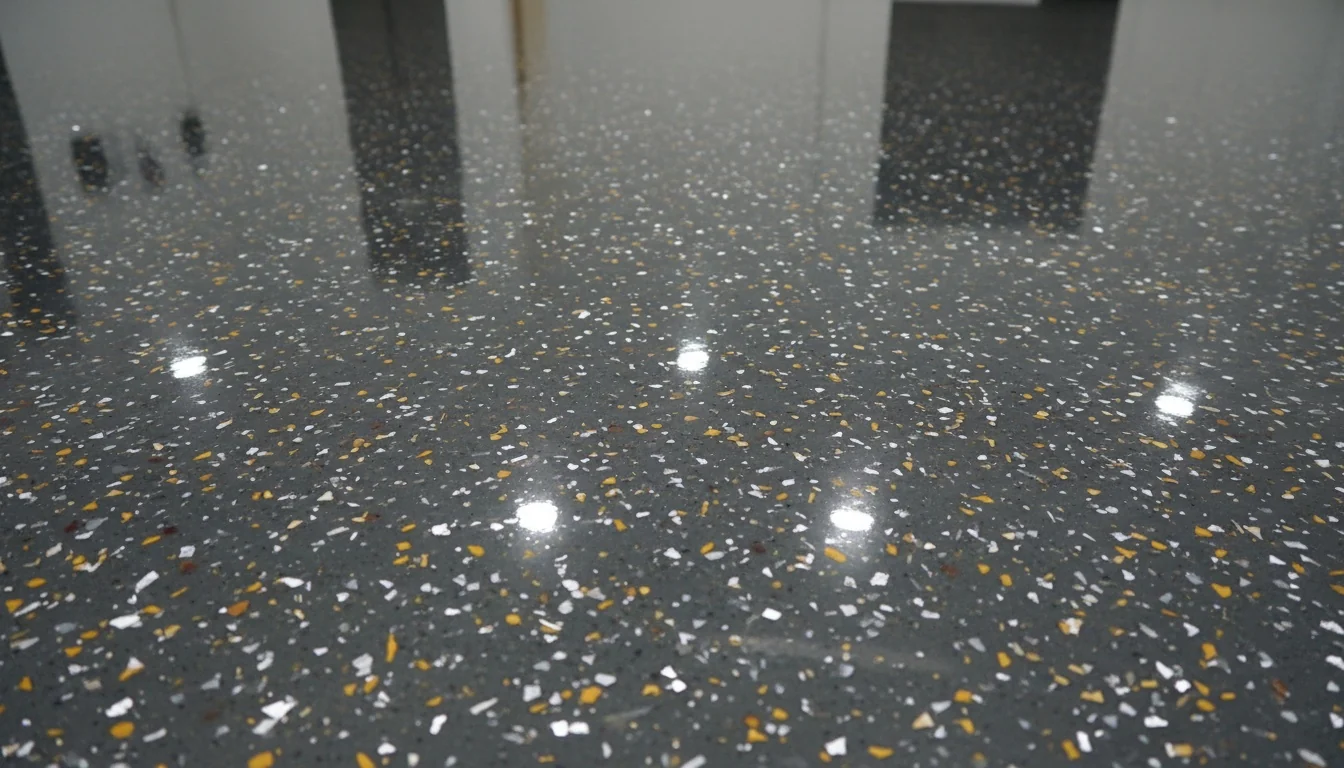
Epoxy Flake Flooring in Johannesburg
Coloured chips locked under a clear coat give a floor that shrugs off spring dust, summer-storm footprints and tyre marks. It is the system most garages and workshops end up with, and we quote it from a free visit to your slab.
Dust from August, rain from November
Johannesburg's year splits in two, and a floor has to cope with both halves. The late-winter months are dry and windy: researchers from the University of Johannesburg and Wits who measured dust on the Witwatersrand found deposition highest from July to October, peaking in August and September. Then the rain arrives. O.R. Tambo averages 10.4 rain days in November, 12.6 in December and 10.2 in January, against 0.3 in July.
A single flat colour shows both seasons: a film of dust in spring and a trail of wet footprints in summer. A floor broadcast with coloured chips breaks up the surface, so a light dusting or a dried footprint barely registers between cleans, and the chips add some texture underfoot. Where the floor gets wet at a door, a fine grit goes into the clear coat as well.
Four reasons people pick flake
It hides the dust
The speckle disguises the fine grit that blows in through the dry, windy months, so the floor looks clean for longer between mops.
Better footing when wet
The chips give the surface some texture, and a fine grit in the clear coat adds more grip at doorways and wash areas.
Any colour mix
Greys and neutrals for a garage, or a bolder blend to match a shop or gym. Full or partial cover changes the look again.
Sealed under clear coats
The clear layers on top take the wear and keep oil and spills on the surface, where a mop or hose lifts them.
Epoxy flake pricing in Johannesburg
Flake is priced per square metre and sits between solid colour and metallic. Our 2026 guide figures:
- Flake band: R350 to R1,200 per m²
- Single garage, about 18 m², at the band floor: about R6,300
- Double garage, about 36 m², at the band floor: about R12,600
- Full broadcast, extra clear coats and grit move you up the band
Part of the spread is material. The clear coat over a broadcast floor is a proper layer, not a wipe: one South African data sheet gives 0.6 to 0.8 kg of resin per m² for the seal coat on a broadcast system, and each extra coat adds to it. The rest is the slab: grinding, crack repairs and damp treatment are itemised in the quote. Every system is compared on the epoxy flooring price guide.
Sources: Mpanza, Adam & Moolla (2020), windblown dust on the Witwatersrand, IJERPH · Johannesburg O.R. Tambo climate normals 1991–2020, rain days per month · Epoxy floor coating product data sheet, South Africa (Sept 2026): broadcast systems.
Four steps to a flake floor
Grind, repair, prime
The slab is diamond-ground and checked for damp, cracks and holes are filled, and a primer goes down for the base to grip.
Base coat, then chips
The coloured base is rolled out and the chips are thrown onto it while it is wet, to a light speckle or a full cover.
Scrape back, seal
Once cured, loose chips are scraped and vacuumed off, then the clear coats go on, with grit added where you want grip.
Let it cure
Foot traffic after about a day, cars after five to seven days in mild weather, longer when the slab is cold. On a windy day the doors stay shut while it is wet.
Flake-chip floors across Johannesburg
Site visits are free anywhere in the city. Three of the areas with their own page:
Epoxy flake flooring: your questions
Price, layers, dust, grip and cure times, answered before you book.
Price a flake floor for your space
Book a free visit and we will check the slab, show you chip blends and give you a fixed price. Coating a garage? See our garage floor coating page, or compare every system on the Johannesburg epoxy flooring home page.