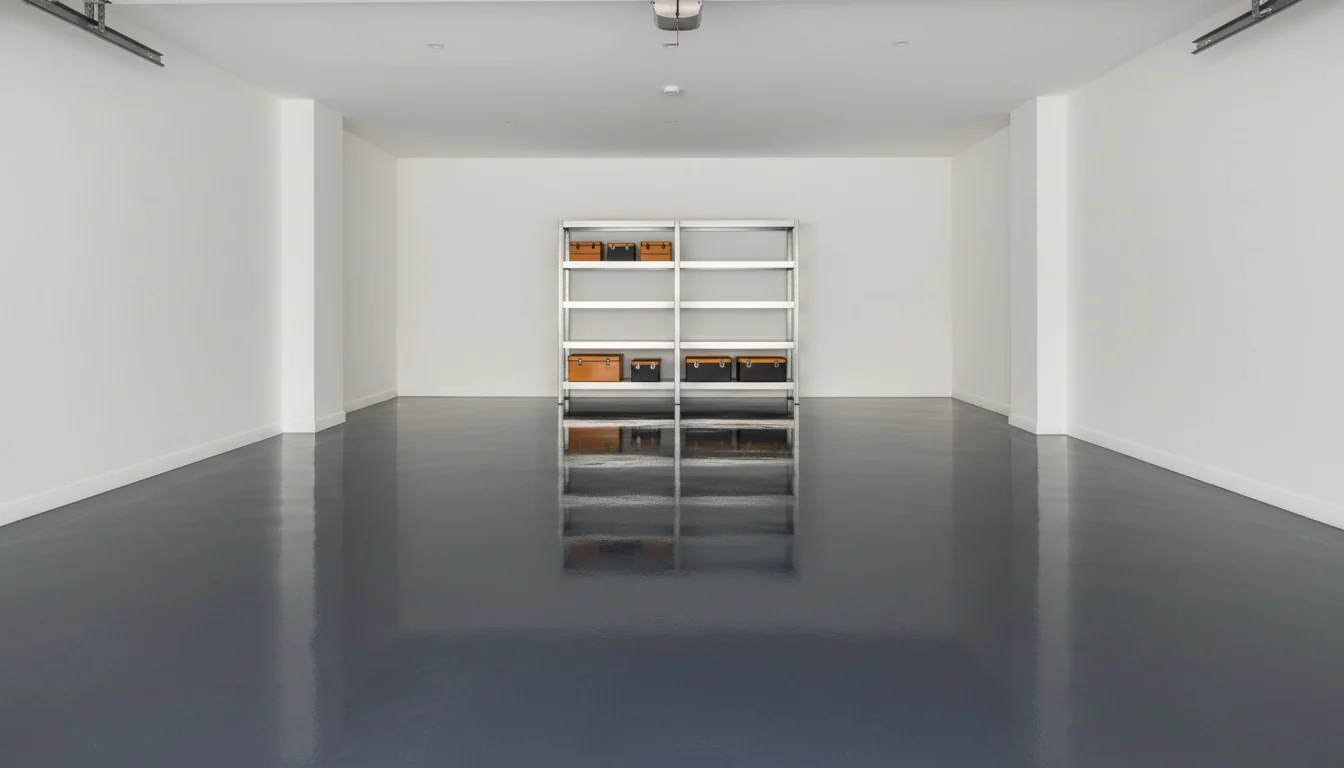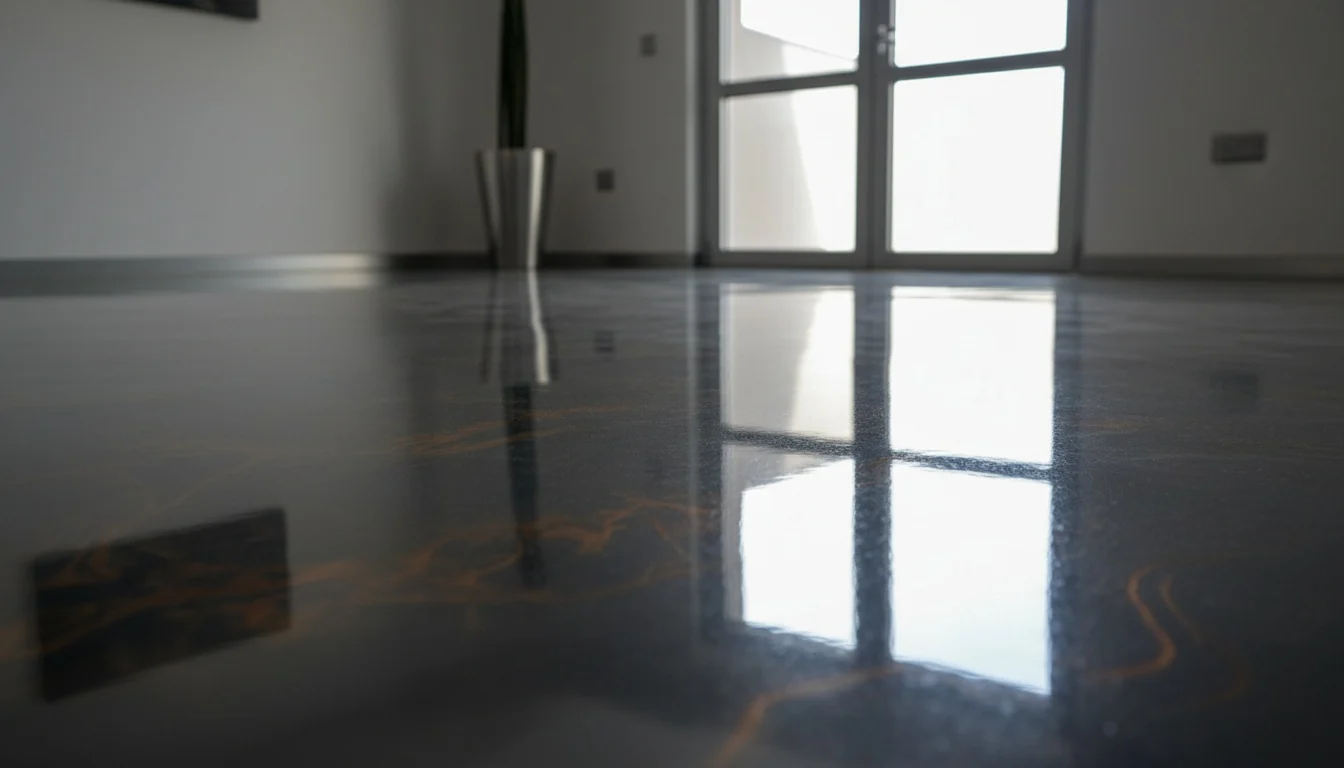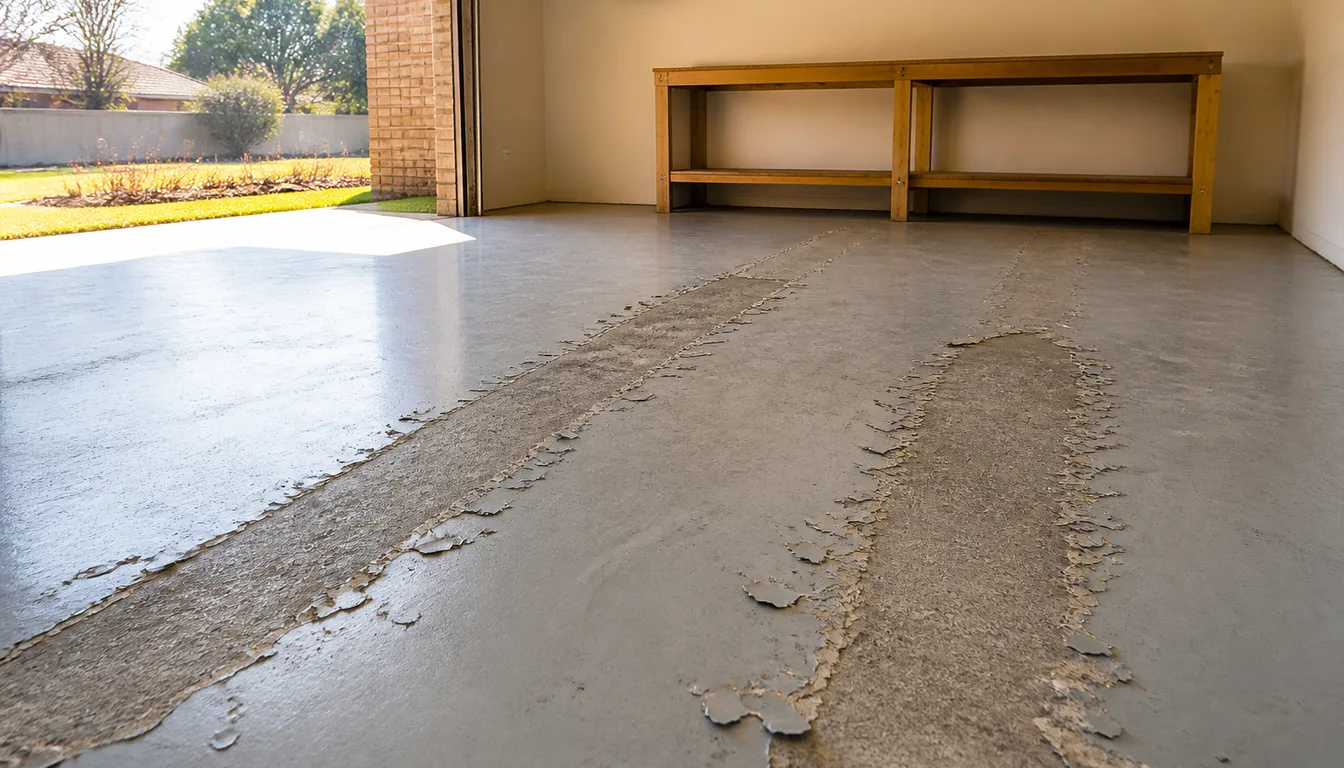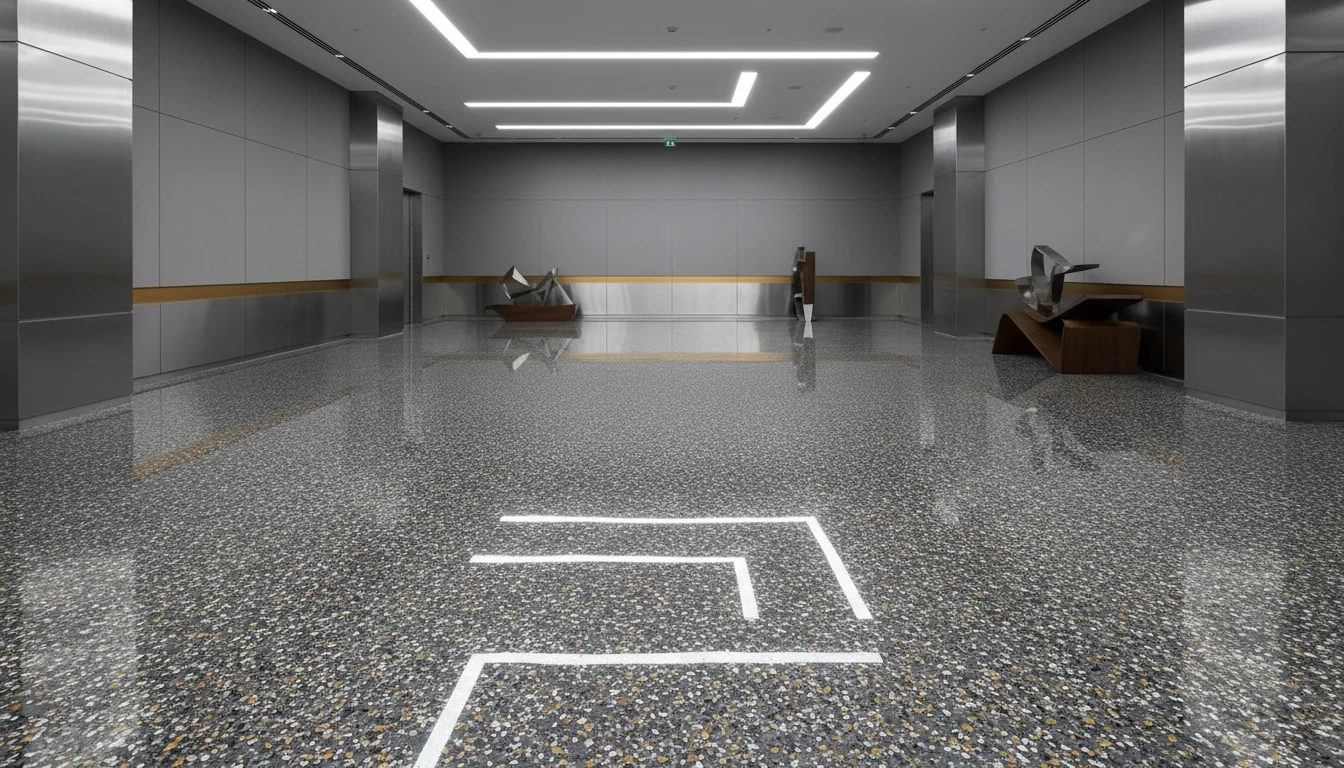

In Johannesburg, whether an epoxy floor is slippery is mostly a question about the calendar. Of the 720 mm of rain O.R. Tambo gets in an average year, 628 mm falls between October and March, much of it in short afternoon storms. July averages 0.3 days of rain. So a gloss floor that feels perfectly safe when it is quoted in winter can be a very different surface in December, when wet shoes and tyres come through the door several times a week.
Dry epoxy is not slippery. Wet, oily or dusty epoxy can be, if the top coat is smooth. This guide covers when the risk appears, how slip resistance is measured, what South African rules do and do not require, and how grip is built into the floor before it is finished.
Key takeaways
- Clean and dry, epoxy grips fine. A liquid or dust film on a smooth gloss coat is what makes it slippery.
- About 87% of Johannesburg's rain falls October to March, so grip should be specified for summer, not for the dry day the quote is done.
- Grip comes from aggregate sealed into the top coat, chosen to balance traction against comfort and cleaning.
- Two test systems exist, the pendulum (PTV) and the ramp (R9–R13), and they do not convert into each other.
- South African building rules require wet-room floors to be water-resistant and access routes to be slip-resistant, but set no slip number for a home. The spec is your protection.
When an epoxy floor actually gets slippery
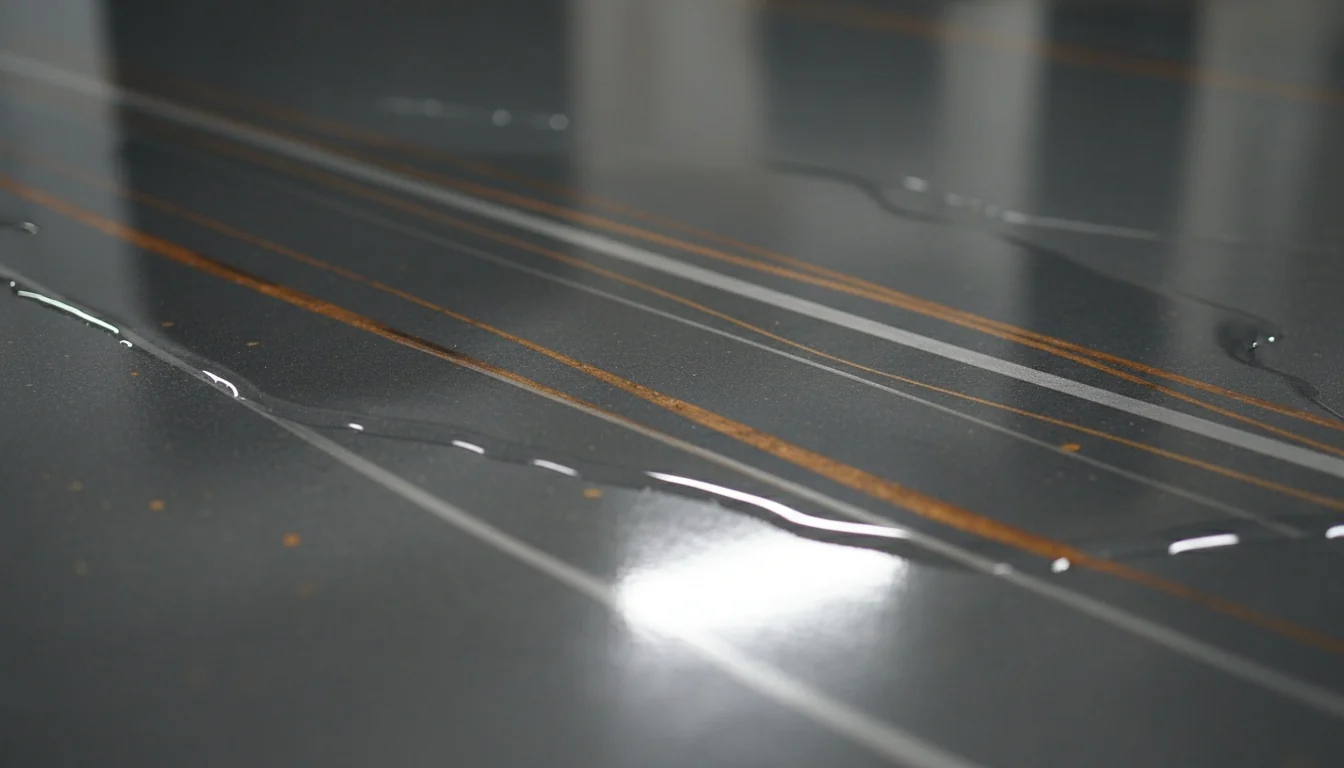
Cured epoxy is dense and non-porous. That is good for cleaning, and it is also the problem: water has nowhere to go, so it spreads into a thin layer and your sole rides on the layer instead of the floor. Texture breaks that layer up. A smooth gloss coat has none.
Here is how the Highveld's seasons line up with the usual culprits:
| Season | What the numbers say | What ends up on the floor |
|---|---|---|
| Storm season, November to March | Regular afternoon thunderstorms; December averages 12.6 rain days | Rain blown under garage doors, wet shoes at entrances, puddles on patios |
| Shoulder months, April and October | 4.7 and 7.0 rain days on average | Occasional storms, so wet days are less frequent but less expected |
| Dry season, May to September | July averages 0.3 rain days | Fine dust on gloss floors, which rolls underfoot much like grit |
Water is not the only film. Oil and coolant in a workshop are more slippery than rain, soap left by an over-strong cleaning mix leaves a slick, and wash-down water is a daily thing in kitchens and food areas. None of this is a reason to avoid epoxy. It is a reason not to put a smooth gloss finish anywhere liquid regularly lands.
How slip resistance is measured
Quotes and data sheets use two different scales. Both are legitimate. They test different things, and knowing which one you are being given helps you compare.
The pendulum test (PTV)
A weighted arm with a rubber foot swings across the floor, and the drag it meets gives a Pendulum Test Value. The UK Health and Safety Executive uses it as its standard method and groups the results like this: 0 to 24 is high slip potential, 25 to 35 moderate, 36 and over low. The big practical advantage is that it can be run on the installed floor, not just a sample in a lab.
The HSE also publishes a quicker check based on surface roughness, measured with a hand-held meter. For floors that get wet with water, a roughness (Rz) below 10 microns means high slip potential, 10 to 20 moderate, and over 20 low. A smooth gloss epoxy sits at the wrong end of that scale; grit in the top coat is what moves it.
The ramp test (R9 to R13)
In the German ramp method a sample is laid on a tilting platform and coated with motor oil. Someone in heavily cleated safety boots walks on it while it tilts, and the angle at which they lose footing sets the class.
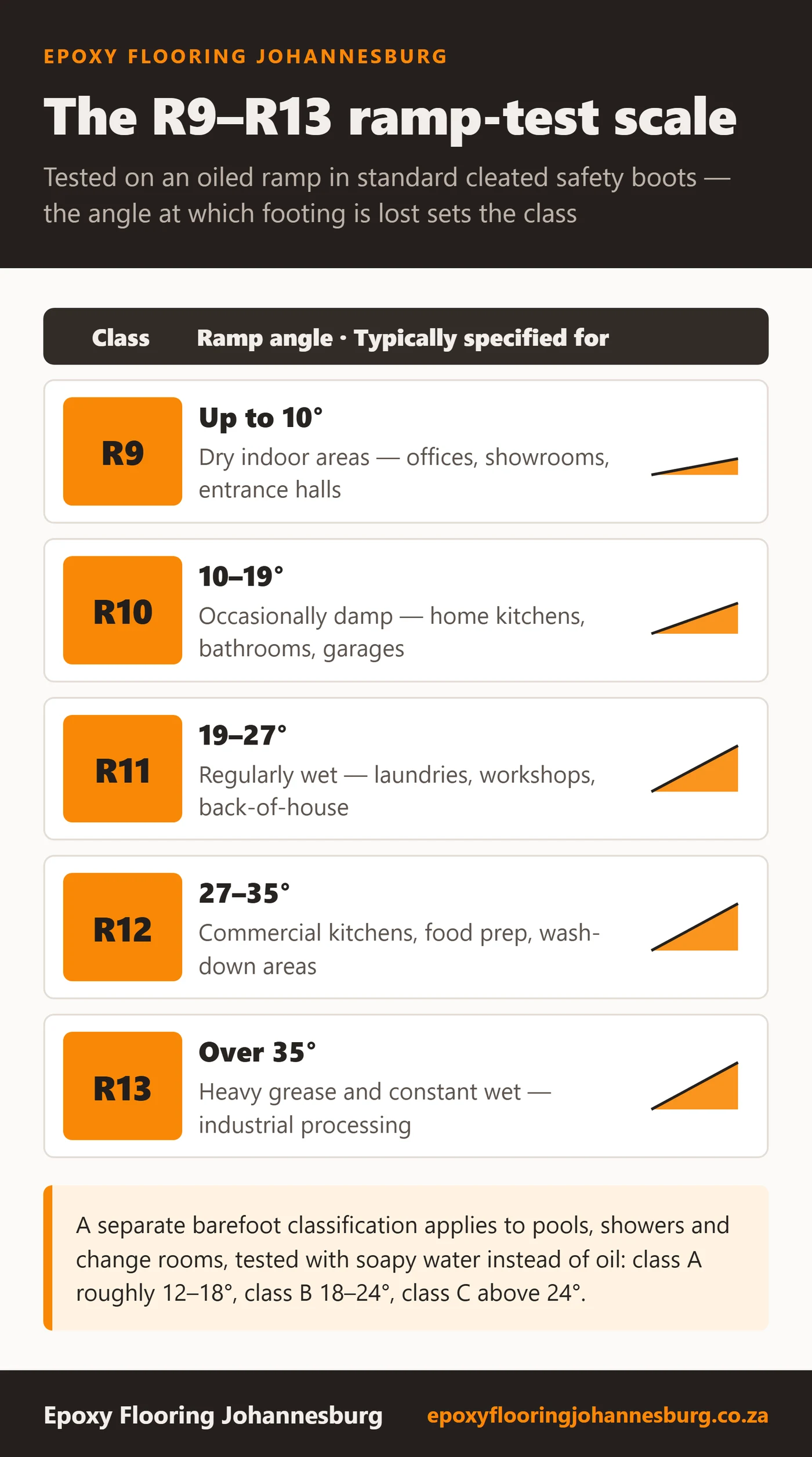
| Class | Slip angle, per the HSE | What to read into it |
|---|---|---|
| R9 | 6–10° | The HSE says R9 floors will be slippery when wet or greasy |
| R10 | 10–19° | A wide band; the HSE says some R10 floors are also slippery when wet |
| R11 | 19–27° | A sensible minimum to ask about for areas that are wet regularly |
| R12 | 27–35° | Heavier texture, harder to clean |
| R13 | Over 35° | The coarsest class |
A separate barefoot version uses soapy water instead of oil, for showers, pools and change rooms. The HSE gives its classes as A at 12 to 17 degrees, B at 18 to 23 and C above 24, and warns that A, and often B, floors will be slippery when wet.
Two cautions before you lean on an R number. First, the HSE has reservations about both ramp tests, because motor oil and soap are not what usually ends up on a workplace floor. Second, the ranges are wide: R10 alone covers a friction range of 0.18 to 0.34, which is a big spread of real-world grip. You cannot convert an R class into a PTV either. Treat an R class as a description of the system on paper, and ask what grit is going into the top coat.
How grip is built into an epoxy floor
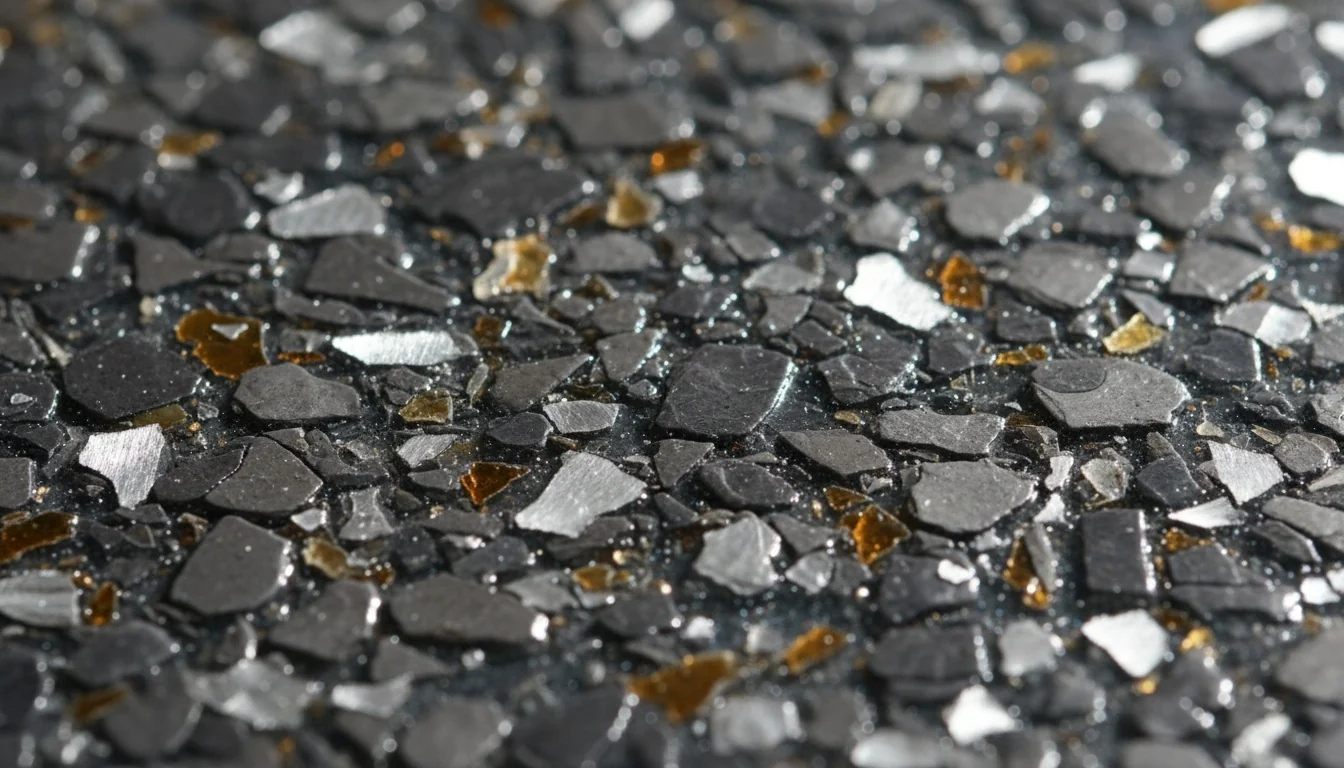
One South African data sheet for an epoxy floor coating describes the broadcast method in plain steps. A coat goes down, quartz sand is thrown over it until no wet resin shows, the coat is left to set, the loose sand is vacuumed off, and a seal coat is applied at 0.4 to 0.6 litres per m² to encapsulate the grains completely. That last step matters: grit that is not sealed in breaks loose and the grip goes with it.
The main choices of texture:
- Fine quartz sand. The common choice for garages, patios and utility rooms. It gives a fine, even texture with real grip.
- Aluminium oxide. Much harder, so it keeps its edge under forklifts and trolleys. Too sharp for bare feet.
- Polymer beads. Rounded rather than angular, so they are gentler on skin and easier to mop. The usual pick for bathrooms and pool surrounds.
- Flake and quartz systems. These carry some texture of their own from the broadcast chips, and an extra fine grit can be added to the final clear coat where needed.
Decorative products say the same. A metallic epoxy data sheet from Nippon Paint recommends a textured or anti-slip system wherever a floor has to meet a slip requirement in wet or contaminated conditions. There is always a trade-off: the grippier the texture, the more it holds dirt and the harsher it is on bare feet. It is one of the disadvantages of epoxy flooring that is managed rather than removed.
Timing the job around the storms
The same South African data sheet says a freshly applied coat must be kept away from damp, condensation and water for at least 24 hours. In summer, with regular afternoon storms from November to March, that shapes the day on an open patio or at a garage door that faces the weather. We plan coats so the last one is not left exposed to an afternoon downpour, and if the forecast turns, the work moves rather than the cure being gambled.
Choosing the level of grip for each room
More grip is not automatically better. Too much texture in a living room makes it a chore to clean for no gain; too little at a back door creates a hazard. A practical split for a Johannesburg home:
- Smooth is fine: lounges, bedrooms, studies and indoor entrance halls that stay dry.
- Add fine texture: kitchens, sculleries, laundries and bathrooms, and the first couple of metres inside a garage door that storms reach.
- Add firm texture: uncovered patios, pool surrounds and outdoor steps.
Businesses carry more risk, because a slip on your floor is your problem. Kitchens, food production, wash bays and cold rooms need grip designed in from the start, which is part of every commercial and industrial floor specification we write.
Texture also changes how a floor wears and how it is cleaned, so the slip decision and the lifespan of the floor are worth weighing together.
What South African rules say
There is no single slip number a South African home floor has to meet. What the rules do say:
- Water resistance in wet rooms. Under the National Building Regulations, floors of laundries, kitchens, shower-rooms, bathrooms and rooms with toilets must be water-resistant. A seamless epoxy floor meets that easily. It says nothing about grip.
- Slip-resistant access routes. The 2025 edition of SANS 10400 Part S, which covers access for people with disabilities, calls for access routes to have uniform, textured, firm, stable and slip-resistant finishes on level and sloping surfaces, according to a June 2026 briefing for architects on the new edition. That matters for ramps and entrances on commercial buildings.
- A safe workplace. Section 8(1) of the Occupational Health and Safety Act requires every employer to provide and maintain, as far as reasonably practicable, a working environment that is safe and without risk to health. It gives no figure, which leaves the employer to show the floor was a reasonable choice.
In other words, nobody checks a home floor's grip for you. If a room gets wet and the quote does not say what is going into the top coat, ask before you sign.
The bottom line
Epoxy is slippery only when a smooth finish meets a wet, oily or dusty surface, and in Johannesburg the wet part arrives on a schedule: October to March. Ask how wet the room gets, who walks on it and in what shoes, and what texture is proposed for those conditions. Then get that written into the quote. Book a free on-site quote and we will look at the room, the drainage and the traffic, and put the grip specification on paper with the price.