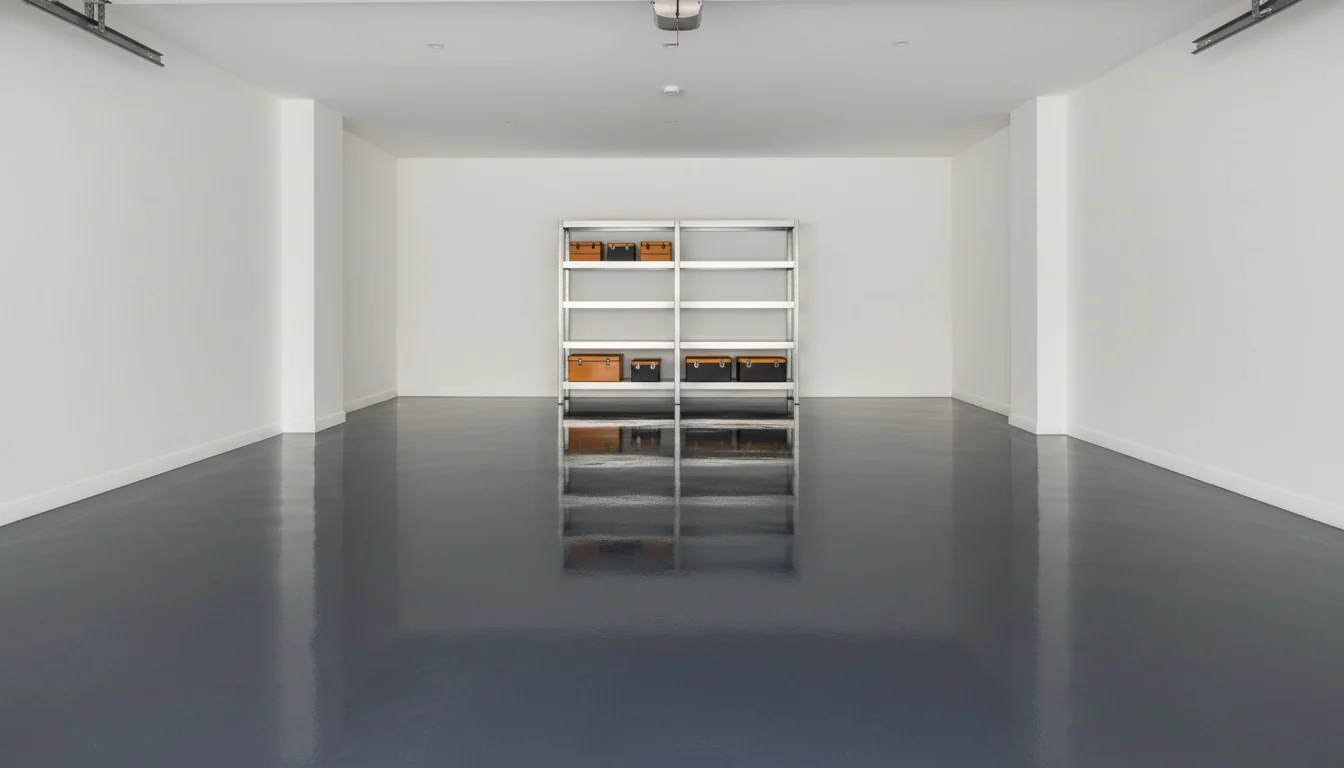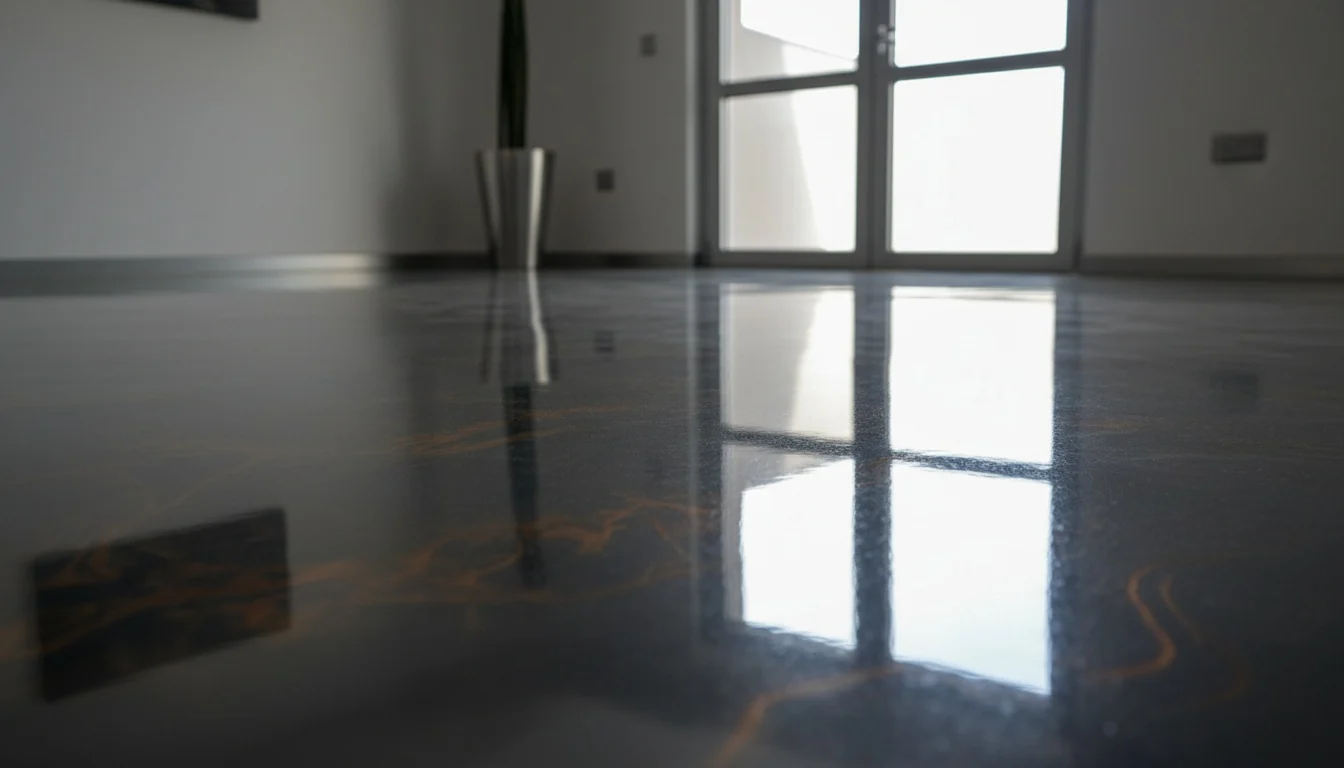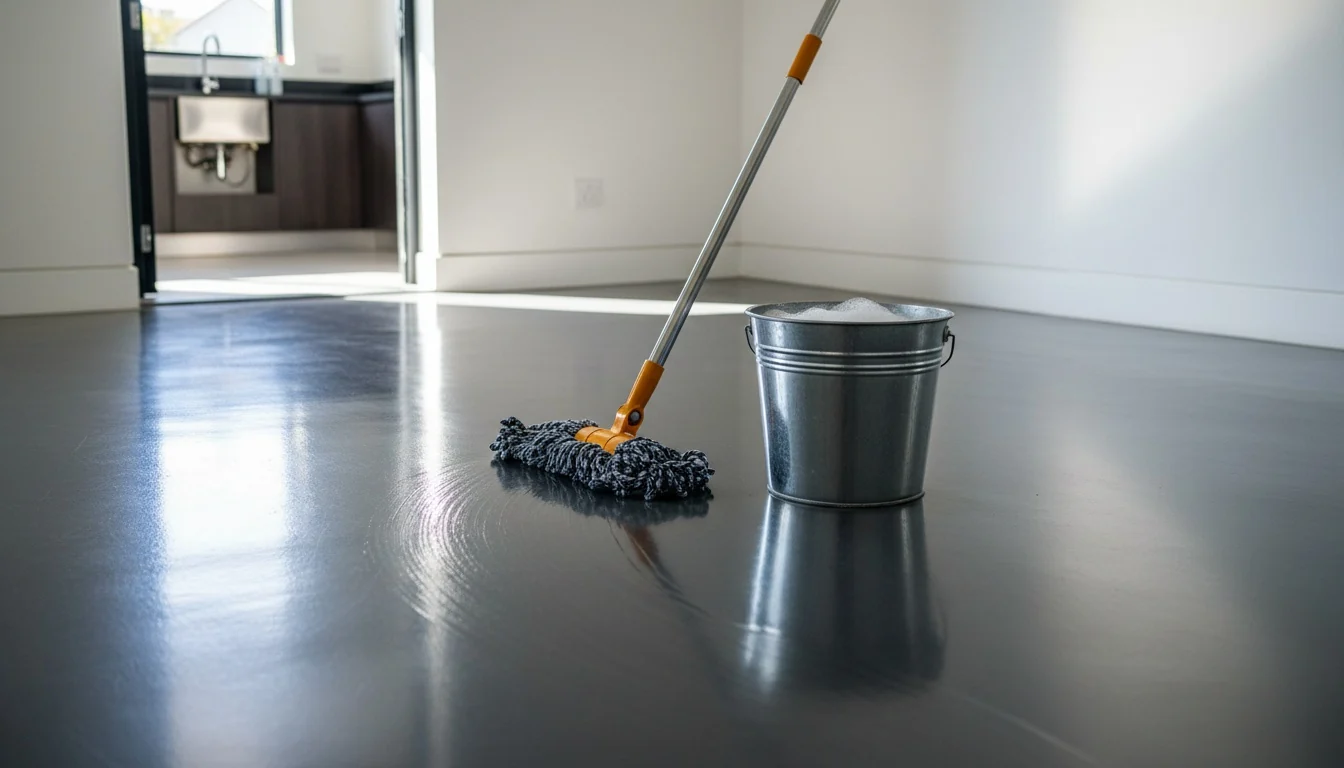

An epoxy floor asks very little of you. There is no grout to scrub, no seasonal sealing ritual and no special equipment to buy. But low maintenance is not no maintenance, and the handful of owners who end up disappointed with a dull floor almost always got there by cleaning it wrongly — or by not sweeping it. That second one is the Johannesburg story in particular, because the thing most likely to take the shine off a floor here is not a spill or a cleaning product. It is fine Highveld dust, walked into the surface day after day through a long dry winter. This guide covers the routine that keeps a floor looking poured, the products and tools that quietly ruin one, and the one kind of dulling that no amount of mopping will fix.
Key takeaways
- Sweeping beats mopping. Grit is abrasive; on the Highveld there is a lot of it for a lot of the year. Lifting dust before it gets walked in is the single highest-value habit.
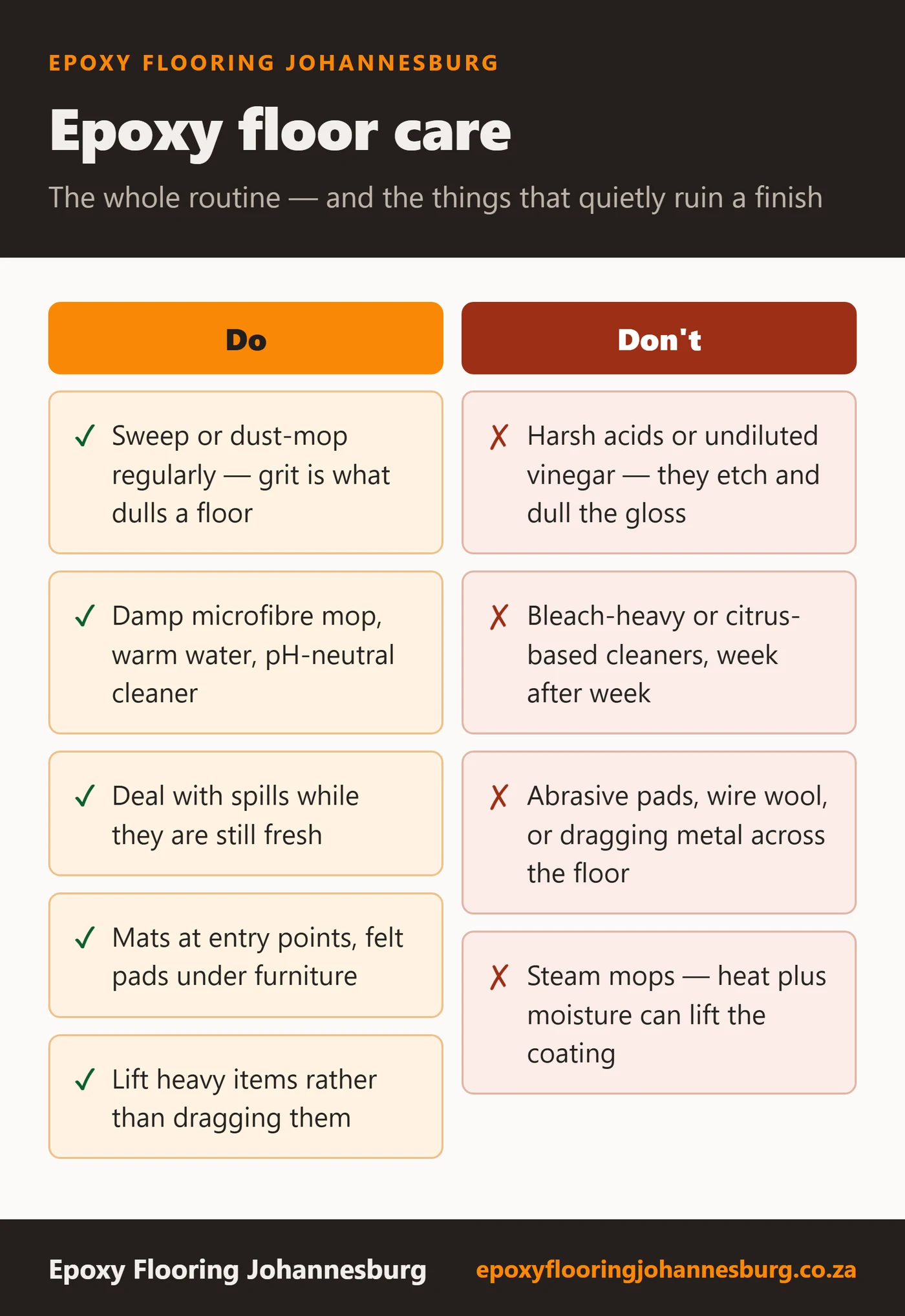
- Warm water and a pH-neutral cleaner is the whole product list. Acids, vinegar, bleach, citrus cleaners and abrasive pads all etch or dull the coating.
- The seasons change the job. Dry winters are about dust; the summer storm months are about grit washing in off the driveway and wet floors underfoot.
- Know the difference between dirt, wear and UV. Two of those you can clean. The third needs a new top coat, and it is the one our altitude makes more likely.
The routine that actually matters
Almost everything about caring for an epoxy floor comes down to keeping abrasive particles off it. Fine sand and dust behave like sandpaper underfoot, and over months they, rather than any spill, are what takes a floor from glossy to flat. This is where Johannesburg differs from the coast in a way that is easy to underestimate: our winters run dry and sunny from about May to September with very little rain to settle anything, so a fine, pale dust gets onto every hard surface and stays there. An open garage door or a patio sliding door is a direct route for it.
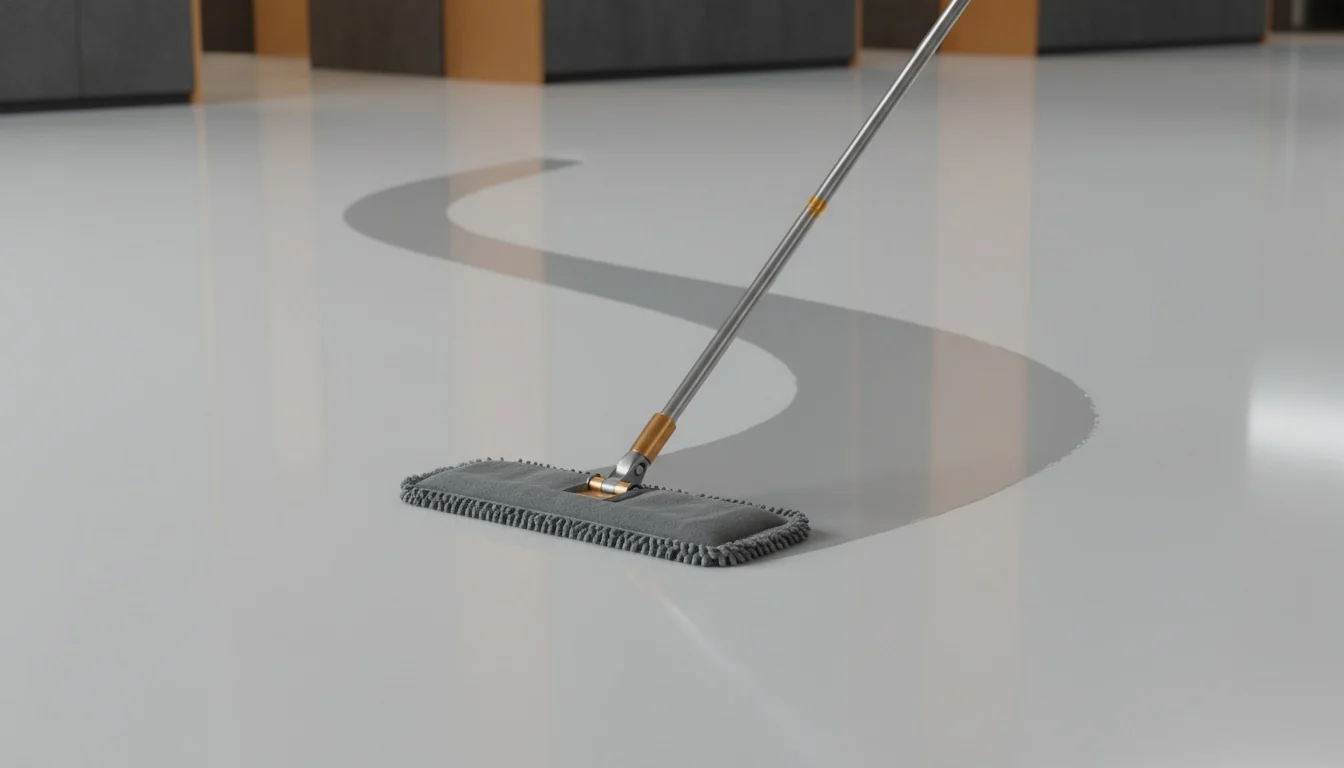
So the highest-value habit is also the least glamorous one — a regular pass with a soft broom or, better, a dust mop that traps fine particles instead of flicking them into the air. In a garage or workshop, twice a week through winter is not excessive. Do that and the wash becomes almost incidental: a microfibre mop, warm water and a small dose of pH-neutral cleaner of the kind sold for sealed floors. Wring the mop until it is damp rather than dripping, work in sections, and follow with clean warm water if you have used cleaner so nothing dries into a film. Indoor floors are no different — residential epoxy floors get the same gentle treatment as a garage bay, just more often where there is more foot traffic.
A Johannesburg floor has two seasons
Most maintenance advice is written as though the year is uniform. Here it is not, and the two halves ask for different things.
The dry months, roughly May to September. This is dust season. Rain is infrequent, the air is dry, and the job is almost entirely mechanical: sweep or dust-mop often, keep matting at every entrance, and resist the temptation to deal with a dusty floor by mopping it more — dragging grit around in water scratches just as effectively as walking on it. Lift it dry first, every time.
The storm months, roughly November to March. Afternoon thunderstorms arrive almost daily through the Highveld summer, and they change the problem in two ways. Runoff washes sand and grit off a driveway and deposits it at the garage threshold, so that is where matting earns its keep. And a wet glossy floor is a slippery one — if your floor was specified without an anti-slip additive in the areas that catch water, the storm season is when you will notice. That is a specification issue rather than a cleaning one. It is covered in detail in our piece on whether epoxy is slippery, and more broadly in our rundown of the pros and cons of epoxy, but the short-term fix is a mat and the habit of mopping standing water rather than leaving it.
What to avoid
This is where floors get damaged, so it is worth being blunt. The common mistake is reaching for something far more aggressive than the job needs. Acids and acidic cleaners etch and dull the surface. Vinegar counts — it is mild as acids go and popular as a natural cleaner, but week after week it works away at the gloss, so it does not belong in a routine. Bleach-heavy and citrus-based products sit in the same category: survivable once, corrosive as a habit.
Tools matter as much as products. Scouring pads, wire wool and stiff wire brushes scratch the finish, and so does sliding anything heavy and metal across it — a toolbox, a steel shelving unit, a trolley jack. Steam mops are worth skipping entirely: heat plus moisture is unnecessary on a sealed floor and can soften a coating over time. Soft tools, neutral chemistry, and the finish holds.
Spills, oil and tyre marks
Epoxy is non-porous, and that single property does most of the work. Spills sit on the surface rather than soaking in, so there is no race against staining the way there is on bare concrete — almost everything comes up if you get to it in reasonable time. Water, drinks and household messes need a cloth or a damp mop and nothing else.
Oil, grease and chemical drips, which are simply part of life in a working garage, are barely harder. Wipe up the bulk, clean the area with warm water and a pH-neutral or mild degreasing cleaner, rinse. Because nothing penetrates the coating, the permanent dark patches you get on an uncoated slab do not form. Tyre marks deserve their own note because they alarm people: the dark scuffs a hot tyre leaves are deposits sitting on the surface, not stains in the floor. Warm water and a degreaser left to soften for a few minutes, then a soft brush or non-abrasive nylon pad, takes them off. Do not attack a stubborn one with anything metal — the mark will go either way, and only one of those approaches leaves the gloss intact. This is the routine that keeps a garage epoxy floor looking new, since a parked car is where most marking happens.
Dull, worn, or UV-damaged? They are not the same thing
This is the part worth reading twice, because it is the distinction that decides whether a tired-looking floor needs an afternoon or a tradesman — and the one our altitude makes more relevant than it would be at sea level.
- Dirty looks patchy and uneven, worst along walking lines and at doorways. It responds to cleaning, and if a proper sweep and wash brings the shine back, that is all it was.
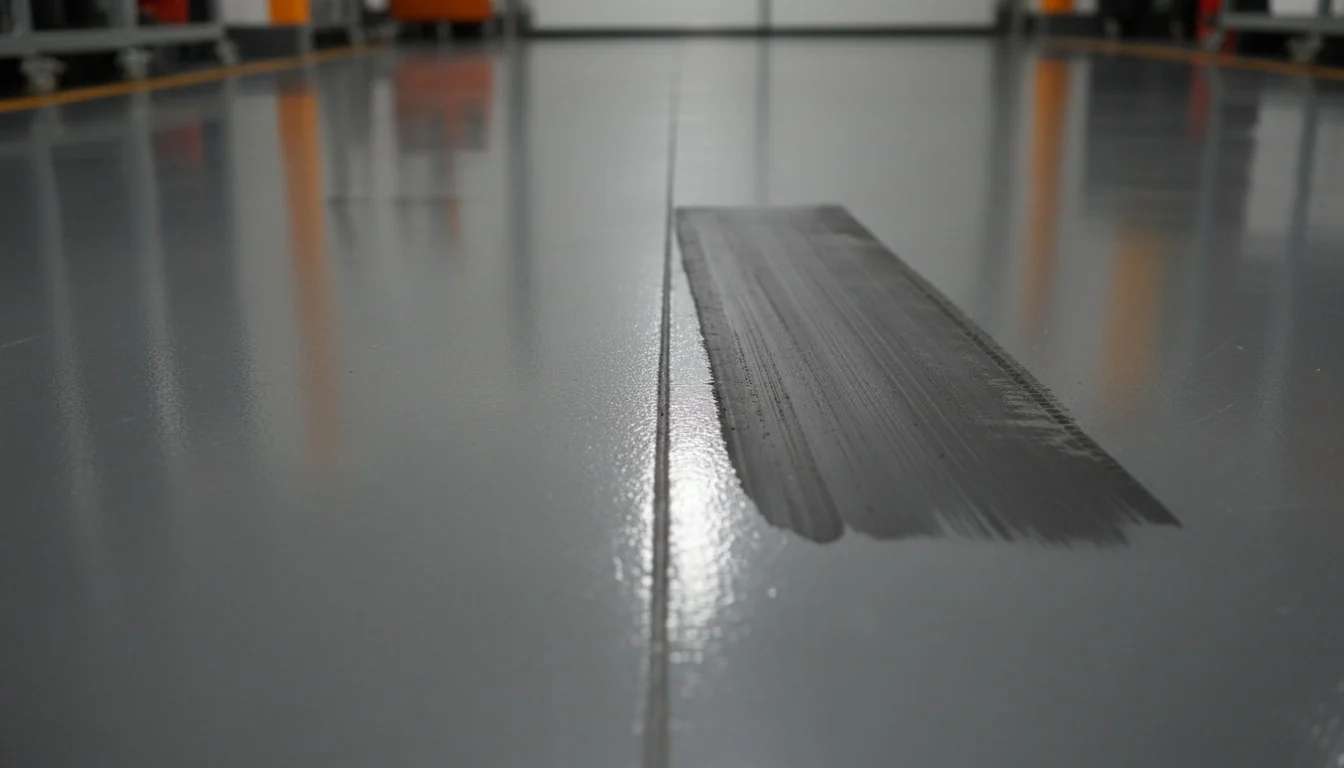
- Worn looks like fine, dense scratching concentrated exactly where traffic goes, with untouched areas still glossy. Cleaning will not fix it, but a fresh top coat restores both the gloss and the protective layer, usually without redoing the floor.
- UV-degraded looks different again: an even chalky flatness, often with a yellow cast, and — the giveaway — it maps onto where the sun falls rather than where people walk. A patch under a north-facing window or the first metre inside a garage door goes while the shaded remainder stays glossy.
That third case is a Johannesburg problem more than a coastal one. Standard epoxy resin is not UV-stable on its own, and UV intensity climbs roughly 12% for every 1,000 m of altitude — at 1,753 m, sunlight here is doing measurably more to a floor than the same sunlight at the sea. No cleaning product reverses it, because the coating itself has changed rather than being covered in something. The fix is a UV-stable top coat, usually an aliphatic polyurethane or a polyaspartic, and the better answer is to have specified one in the first place on any floor that takes direct sun. If you are diagnosing a floor that has lost its shine unevenly, check where the light lands before you buy anything.
Protecting the gloss
Prevention does more for the long-term look of a floor than any product. The aim is to keep abrasion and point-loads off the top layer:
- Matting at every entrance — the highest-return thing on this list, and more so here, because it intercepts both winter dust and summer storm grit before a shoe or a tyre grinds it in.
- Felt pads under anything that moves. Chair legs, workbenches, shelving — cents' worth of felt against a scratch that needs recoating.
- Parking mats in the garage. They stop hot-tyre marks forming and shield the floor where a car stands day after day.
- Lift rather than drag. Use a wheeled trolley or two people; never slide a load across the surface.
Long-term care and when to recoat
Over years, the long game is just the basics repeated: lift the grit, mop gently, deal with spills, keep mats and pads where they belong. Do that and a quality floor holds its gloss and toughness for a long time. It pays to know your own floor, too — an occasional look for chips, worn lines or hairline marks catches wear while it is still a top coat rather than a rebuild.
Eventually a very busy floor loses some shine through sheer use. That is normal wear, not failure, and a fresh top coat restores the gloss and the protection without redoing the whole installation. In a typical Johannesburg home that is a long way off. If you want the detail on what makes one floor outlast another, we go into how long an epoxy floor lasts separately, and when the time does come we will assess the floor on site and say honestly whether a top coat or a fuller redo is the right call. Costs for that are set out on our Johannesburg epoxy pricing guide.
The short version
Sweep more than you think you need to, especially through the dry months. Wash with warm water and a pH-neutral cleaner, and keep every acid, bleach, citrus cleaner and abrasive pad away from the floor. Catch spills while they are fresh. Put mats at the doors and felt under the furniture. Anything still unclear is probably answered on our epoxy flooring FAQ. And if the shine goes patchy, work out whether you are looking at dirt, at traffic wear or at sun damage before you spend anything — up here, it is more often the sun than people expect.